
Model Context Protocol (MCP) finally gives AI models a way to access the business data needed to make them really useful at work. CData MCP Servers have the depth and performance to make sure AI has access to all of the answers.
Try them now for free →


How to Work with Adobe Target Data in AWS Glue Jobs Using JDBC
Connect to Adobe Target from AWS Glue jobs using the CData JDBC Driver hosted in Amazon S3.
AWS Glue is an ETL service from Amazon that allows you to easily prepare and load your data for storage and analytics. Using the PySpark module along with AWS Glue, you can create jobs that work with data over JDBC connectivity, loading the data directly into AWS data stores. In this article, we walk through uploading the CData JDBC Driver for Adobe Target into an Amazon S3 bucket and creating and running an AWS Glue job to extract Adobe Target data and store it in S3 as a CSV file.
Upload the CData JDBC Driver for Adobe Target to an Amazon S3 Bucket
In order to work with the CData JDBC Driver for Adobe Target in AWS Glue, you will need to store it (and any relevant license files) in an Amazon S3 bucket.
- Open the Amazon S3 Console.
- Select an existing bucket (or create a new one).
- Click Upload
- Select the JAR file (cdata.jdbc.adobetarget.jar) found in the lib directory in the installation location for the driver.
Configure the Amazon Glue Job
- Navigate to ETL -> Jobs from the AWS Glue Console.
- Click Add Job to create a new Glue job.
- Fill in the Job properties:
- Name: Fill in a name for the job, for example: AdobeTargetGlueJob.
- IAM Role: Select (or create) an IAM role that has the AWSGlueServiceRole and AmazonS3FullAccess permissions policies. The latter policy is necessary to access both the JDBC Driver and the output destination in Amazon S3.
- Type: Select "Spark".
- Glue Version: Select "Spark 2.4, Python 3 (Glue Version 1.0)".
- This job runs: Select "A new script to be authored by you".
Populate the script properties: - Script file name: A name for the script file, for example: GlueAdobeTargetJDBC
- S3 path where the script is stored: Fill in or browse to an S3 bucket.
- Temporary directory: Fill in or browse to an S3 bucket.
- Expand Security configuration, script libraries and job parameters (optional). For Dependent jars path, fill in or browse to the S3 bucket where you uploaded the JAR file. Be sure to include the name of the JAR file itself in the path, i.e.: s3://mybucket/cdata.jdbc.adobetarget.jar
- Click Next. Here you will have the option to add connection to other AWS endpoints. So, if your Destination is Redshift, MySQL, etc, you can create and use connections to those data sources.
- Click "Save job and edit script" to create the job.
- In the editor that opens, write a python script for the job. You can use the sample script (see below) as an example.
Sample Glue Script
To connect to Adobe Target using the CData JDBC driver, you will need to create a JDBC URL, populating the necessary connection properties. Additionally, you will need to set the RTK property in the JDBC URL (unless you are using a Beta driver). You can view the licensing file included in the installation for information on how to set this property.
To connect to Adobe Target, you must provide the Tenant property along with OAuth connection properties mentioned below. Note that while other connection properties can influence processing behavior, they do not affect the ability to connect.
To determine your Tenant name:
- Log in to Adobe Experience. The URL will look similar to: "https://experience.adobe.com/#/@mycompanyname/preferences/general-section".
- Extract the value after the "/#/@". In this example, it is "mycompanyname".
- Set the Tenant connection property to that value.
User Accounts (OAuth)
You must set AuthScheme to OAuthClient for all user account flows.
Note: Adobe authentication via OAuth requires updating your token every two weeks.
All Applications
CData provides an embedded OAuth application that simplifies OAuth authentication. Alternatively, you can create a custom OAuth application. Review Creating a Custom OAuth App in the Help documentation for more information.Obtaining the OAuth Access Token
Set the following properties to connect:
- InitiateOAuth: Set to GETANDREFRESH to automatically perform the OAuth exchange and refresh the OAuthAccessToken as needed.
- OAuthClientId : Set to the client Id assigned when you registered your app.
- OAuthClientSecret : Set to the client secret assigned when you registered your app.
- CallbackURL : Set to the redirect URI defined when you registered your app. For example: https://localhost:3333
With these settings, the provider obtains an access token from Adobe Target, which it uses to request data. The OAuth values are stored in the location specified by OAuthSettingsLocation, ensuring they persist across connections.
Built-in Connection String Designer
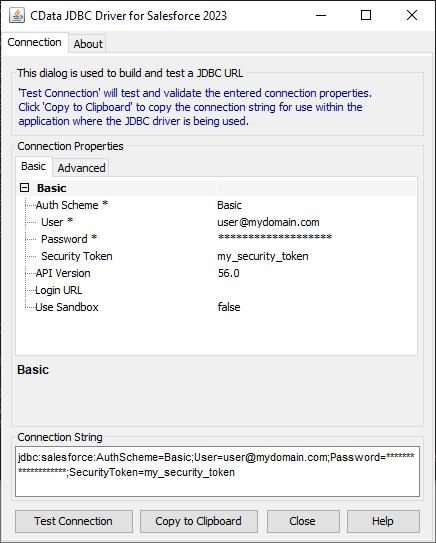
For assistance in constructing the JDBC URL, use the connection string designer built into the Adobe Target JDBC Driver. Either double-click the JAR file or execute the JAR file from the command-line.
java -jar cdata.jdbc.adobetarget.jar
Fill in the connection properties and copy the connection string to the clipboard.
To host the JDBC driver in Amazon S3, you will need a license (full or trial) and a Runtime Key (RTK). For more information on obtaining this license (or a trial), contact our sales team.
Below is a sample script that uses the CData JDBC driver with the PySpark and AWSGlue modules to extract Adobe Target data and write it to an S3 bucket in CSV format. Make any necessary changes to the script to suit your needs and save the job.
import sys
from awsglue.transforms import *
from awsglue.utils import getResolvedOptions
from pyspark.context import SparkContext
from awsglue.context import GlueContext
from awsglue.dynamicframe import DynamicFrame
from awsglue.job import Job

args = getResolvedOptions(sys.argv, ['JOB_NAME'])

sparkContext = SparkContext()
glueContext = GlueContext(sparkContext)
sparkSession = glueContext.spark_session

##Use the CData JDBC driver to read Adobe Target data from the Activities table into a DataFrame
##Note the populated JDBC URL and driver class name
source_df = sparkSession.read.format("jdbc").option("url","jdbc:adobetarget:RTK=5246...;Tenant=mycompanyname;").option("dbtable","Activities").option("driver","cdata.jdbc.adobetarget.AdobeTargetDriver").load()

glueJob = Job(glueContext)
glueJob.init(args['JOB_NAME'], args)

##Convert DataFrames to AWS Glue's DynamicFrames Object
dynamic_dframe = DynamicFrame.fromDF(source_df, glueContext, "dynamic_df")

##Write the DynamicFrame as a file in CSV format to a folder in an S3 bucket.
##It is possible to write to any Amazon data store (SQL Server, Redshift, etc) by using any previously defined connections.
retDatasink4 = glueContext.write_dynamic_frame.from_options(frame = dynamic_dframe, connection_type = "s3", connection_options = {"path": "s3://mybucket/outfiles"}, format = "csv", transformation_ctx = "datasink4")

glueJob.commit()
Run the Glue Job
With the script written, we are ready to run the Glue job. Click Run Job and wait for the extract/load to complete. You can view the status of the job from the Jobs page in the AWS Glue Console. Once the Job has succeeded, you will have a CSV file in your S3 bucket with data from the Adobe Target Activities table.
Using the CData JDBC Driver for Adobe Target in AWS Glue, you can easily create ETL jobs for Adobe Target data, whether writing the data to an S3 bucket or loading it into any other AWS data store.
Ready to get started?
Download a free trial of the Adobe Target Driver to get started:
Download NowLearn more:
 Adobe Target JDBC Driver
Easily connect Java applications with real-time data. Use Adobe Target to manage the data that powers your applications.
