
Model Context Protocol (MCP) finally gives AI models a way to access the business data needed to make them really useful at work. CData MCP Servers have the depth and performance to make sure AI has access to all of the answers.
Try them now for free →


Connect to Adobe Target Data in JRuby
Create a simple JRuby app with access to live Adobe Target data.
JRuby is a high-performance, stable, fully threaded Java implementation of the Ruby programming language. The CData JDBC Driver for Adobe Target makes it easy to integrate connectivity to live Adobe Target data in JRuby. This article shows how to create a simple JRuby app that connects to Adobe Target data, executes a query, and displays the results.
Configure a JDBC Connection to Adobe Target Data
Before creating the app, note the installation location for the JAR file for the JDBC Driver (typically C:\Program Files\CData\CData JDBC Driver for Adobe Target\lib).
JRuby natively supports JDBC, so you can easily connect to Adobe Target and execute SQL queries. Initialize the JDBC connection with the getConnection function of the java.sql.DriverManager class.
To connect to Adobe Target, you must provide the Tenant property along with OAuth connection properties mentioned below. Note that while other connection properties can influence processing behavior, they do not affect the ability to connect.
To determine your Tenant name:
- Log in to Adobe Experience. The URL will look similar to: "https://experience.adobe.com/#/@mycompanyname/preferences/general-section".
- Extract the value after the "/#/@". In this example, it is "mycompanyname".
- Set the Tenant connection property to that value.
User Accounts (OAuth)
You must set AuthScheme to OAuthClient for all user account flows.
Note: Adobe authentication via OAuth requires updating your token every two weeks.
All Applications
CData provides an embedded OAuth application that simplifies OAuth authentication. Alternatively, you can create a custom OAuth application. Review Creating a Custom OAuth App in the Help documentation for more information.Obtaining the OAuth Access Token
Set the following properties to connect:
- InitiateOAuth: Set to GETANDREFRESH to automatically perform the OAuth exchange and refresh the OAuthAccessToken as needed.
- OAuthClientId : Set to the client Id assigned when you registered your app.
- OAuthClientSecret : Set to the client secret assigned when you registered your app.
- CallbackURL : Set to the redirect URI defined when you registered your app. For example: https://localhost:3333
With these settings, the provider obtains an access token from Adobe Target, which it uses to request data. The OAuth values are stored in the location specified by OAuthSettingsLocation, ensuring they persist across connections.
Built-in Connection String Designer
For assistance in constructing the JDBC URL, use the connection string designer built into the Adobe Target JDBC Driver. Either double-click the JAR file or execute the jar file from the command-line.
java -jar cdata.jdbc.adobetarget.jar
Fill in the connection properties and copy the connection string to the clipboard.
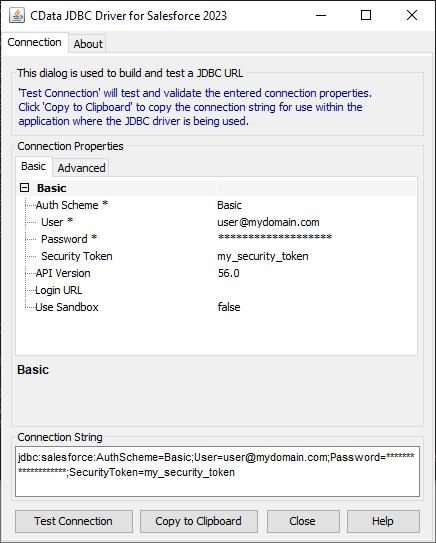
Below is a typical JDBC connection string for Adobe Target:
jdbc:adobetarget:Tenant=mycompanyname;InitiateOAuth=GETANDREFRESH
Create a JRuby App with Connectivity to Adobe Target Data
Create a new Ruby file (for example: AdobeTargetSelect.rb) and open it in a text editor. Copy the following code into your file:
require 'java'
require 'rubygems'
require 'C:/Program Files/CData/CData JDBC Driver for Adobe Target 2018/lib/cdata.jdbc.adobetarget.jar'

url = "jdbc:adobetarget:Tenant=mycompanyname;InitiateOAuth=GETANDREFRESH"
conn = java.sql.DriverManager.getConnection(url)
stmt = conn.createStatement
rs = stmt.executeQuery("SELECT Id, Name FROM Activities")
while (rs.next) do
  puts rs.getString(1) + ' ' + rs.getString(2)
end
With the file completed, you are ready to display your Adobe Target data with JRuby. To do so, simply run your file from the command line:
jruby -S AdobeTargetSelect.rb
Writing SQL-92 queries to Adobe Target allows you to quickly and easily incorporate Adobe Target data into your own JRuby applications. Download a free trial today!
Ready to get started?
Download a free trial of the Adobe Target Driver to get started:
Download NowLearn more:
 Adobe Target JDBC Driver
Easily connect Java applications with real-time data. Use Adobe Target to manage the data that powers your applications.
