
Model Context Protocol (MCP) finally gives AI models a way to access the business data needed to make them really useful at work. CData MCP Servers have the depth and performance to make sure AI has access to all of the answers.
Try them now for free →


Using the CData ODBC Driver for ADP in PyCharm
Connect to ADP as an ODBC data source in PyCharm using the CData ODBC Driver for ADP.
The CData ODBC Drivers can be used in any environment that supports loading an ODBC Driver. In this tutorial we will explore using the CData ODBC Driver for ADP from within PyCharm. Included are steps for adding the CData ODBC Driver as a data source, as well as basic PyCharm code to query the data source and display results.
To begin, this tutorial will assume that you have already installed the CData ODBC Driver for ADP as well as PyCharm.
Add Pyodbc to the Project
Follow the steps below to add the pyodbc module to your project.
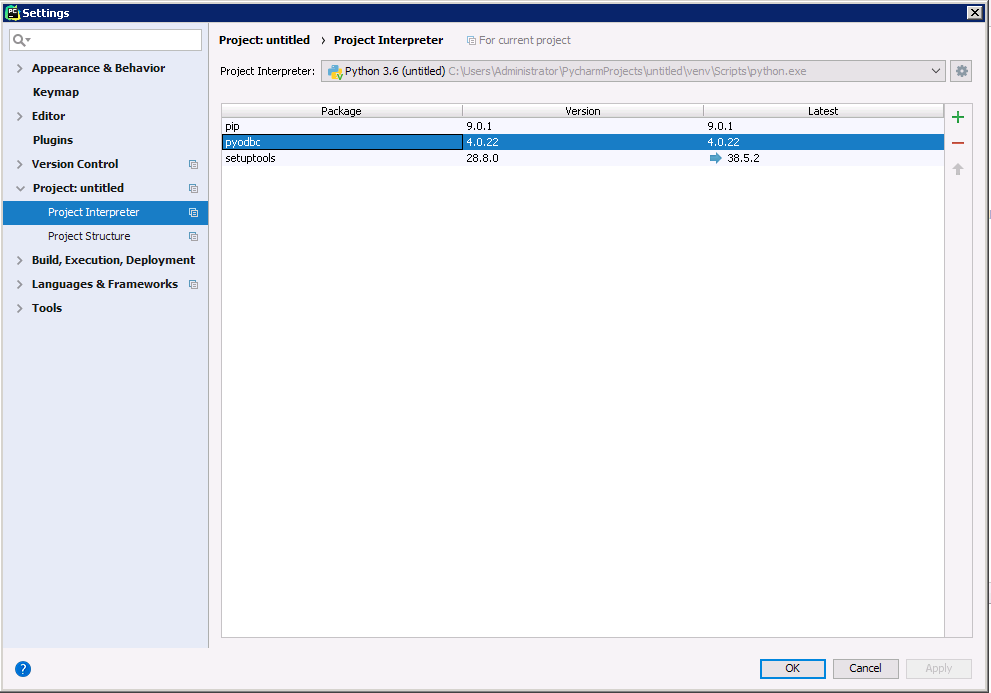
- Click File -> Settings to open the project settings window.
- Click Project Interpreter from the Project: YourProjectName menu.
- To add pyodbc, click the + button and enter pyodbc.
- Click Install Package to install pyodbc.
Connect to ADP
You can now connect with an ODBC connection string or a DSN. See the Getting Started section in the CData driver documentation for a guide to creating a DSN on your OS.
Connect to ADP by specifying the following properties:
- OAuthClientId: The client Id of the custom OAuth application you obtained from ADP.
- OAuthClientSecret: The custom OAuth application's client secret.
- SSLClientCert: Set this to the certificate provided during registration.
- SSLClientCertPassword: Set this to the password of the certificate.
- UseUAT: The connector makes requests to the production environment by default. If using a developer account, set UseUAT = true.
- RowScanDepth: The maximum number of rows to scan for the custom fields columns available in the table. The default value will be set to 100. Setting a high value may decrease performance.
The connector uses OAuth to authenticate with ADP. OAuth requires the authenticating user to interact with ADP using the browser. OAuth access can be configured in ADP through ADP API Central. For more information, refer ADP's API Central Quick Start Guide and the OAuth section in CData's Help documentation.
Below is the syntax for a DSN:
[CData ADP Source]
Driver = CData ODBC Driver for ADP
Description = My Description
OAuthClientId = YourClientId
OAuthClientSecret = YourClientSecret
SSLClientCert = 'c:\cert.pfx'
SSLClientCertPassword = 'admin@123'
Execute SQL to ADP
Instantiate a Cursor and use the execute method of the Cursor class to execute any SQL statement.
import pyodbc

cnxn = pyodbc.connect('DRIVER={CData ODBC Driver for ADP};OAuthClientId = YourClientId;OAuthClientSecret = YourClientSecret;SSLClientCert = 'c:\cert.pfx';SSLClientCertPassword = 'admin@123'')
cursor = cnxn.cursor()
cursor.execute("SELECT AssociateOID, WorkerID FROM Workers WHERE AssociateOID = 'G3349PZGBADQY8H8'")
rows = cursor.fetchall()
for row in rows:
  print(row.AssociateOID, row.WorkerID)
After connecting to ADP in PyCharm using the CData ODBC Driver, you will be able to build Python apps with access to ADP data as if it were a standard database. If you have any questions, comments, or feedback regarding this tutorial, please contact us at [email protected].
Ready to get started?
Download a free trial of the ADP ODBC Driver to get started:
Download NowLearn more:
 ADP ODBC Driver
The ADP ODBC Driver is a powerful tool that allows you to connect with live data from ADP, directly from any applications that support ODBC connectivity.
Access ADP data like you would a database - read, write, and update ADP FALSE, etc. through a standard ODBC Driver interface.
