
Model Context Protocol (MCP) finally gives AI models a way to access the business data needed to make them really useful at work. CData MCP Servers have the depth and performance to make sure AI has access to all of the answers.
Try them now for free →


Migrating data from Bitbucket to Google BigQuery using CData SSIS Components.
Easily push Bitbucket data to Google BigQuery using the CData SSIS Tasks for Bitbucket and Google BigQuery.
Google BigQuery is a serverless, highly scalable, and cost-effective data warehouse designed to help organizations turn big data into actionable insights.
The CData SSIS Components enhance SQL Server Integration Services by enabling users to easily import and export data from various sources and destinations.
In this article, we explore the data type mapping considerations when exporting to BigQuery and walk through how to migrate Bitbucket data to Google BigQuery using the CData SSIS Components for Bitbucket and BigQuery.
Data Type Mapping
| Google BigQuery Schema | CData Schema |
|---|---|
|
STRING, GEOGRAPHY, JSON, INTERVAL |
string |
|
BYTES |
binary |
|
INTEGER |
long |
|
FLOAT |
double |
|
NUMERIC, BIGNUMERIC |
decimal |
|
BOOLEAN |
bool |
|
DATE |
date |
|
TIME |
time |
|
DATETIME, TIMESTAMP |
datetime |
|
STRUCT |
See below |
|
ARRAY |
See below |
STRUCT and ARRAY Types
Google BigQuery supports two kinds of types for storing compound values in a single row, STRUCT and ARRAY. In some places within Google BigQuery, these are also known as RECORD and REPEATED types.
A STRUCT is a fixed-size group of values that are accessed by name and can have different types. The component flattens structs so their fields can be accessed using dotted names. Note that these dotted names must be quoted.
An ARRAY is a group of values with the same type that can have any size. The component treats the array as a single compound value and reports it as a JSON aggregate. These types may be combined such that a STRUCT type contains an ARRAY field, or an ARRAY field is a list of STRUCT values.
Special Considerations
- Google BigQuery has both DATETIME (no timezone) and TIMESTAMP (with timezone) data types that the CData SSIS Components map to datetime based on the timezone of your local machine.
- In Google BigQuery, the NUMERIC type supports 38 digits of precision and up to 9 digits after the decimal point, while the BIGNUMERIC type supports 76 digits of precision and up to 38 digits after the decimal point. The CData SSIS Components for Google BigQuery automatically detects the precision/scale, but with the Destination Component users can manually map any high-precision columns.
-
INTERVAL data types:
-
The component represents INTERVAL types as strings. Whenever a query requires an INTERVAL type, it must specify the INTERVAL using the BigQuery SQL INTERVAL format:
YEAR-MONTH DAY HOUR:MINUTE:SECOND.FRACTION
-
For example, the value "5 years and 11 months, minus 10 days and 3 hours and 2.5 seconds" in the correct format is:
5-11 -10 -3:0:0.2.5
-
The component represents INTERVAL types as strings. Whenever a query requires an INTERVAL type, it must specify the INTERVAL using the BigQuery SQL INTERVAL format:
Prerequisites
- Visual Studio 2022
- SQL Server Integration Services Projects extension for Visual Studio 2022
- CData SSIS Components for Google BigQuery
- CData SSIS Components for Bitbucket
Create the project and add components
-
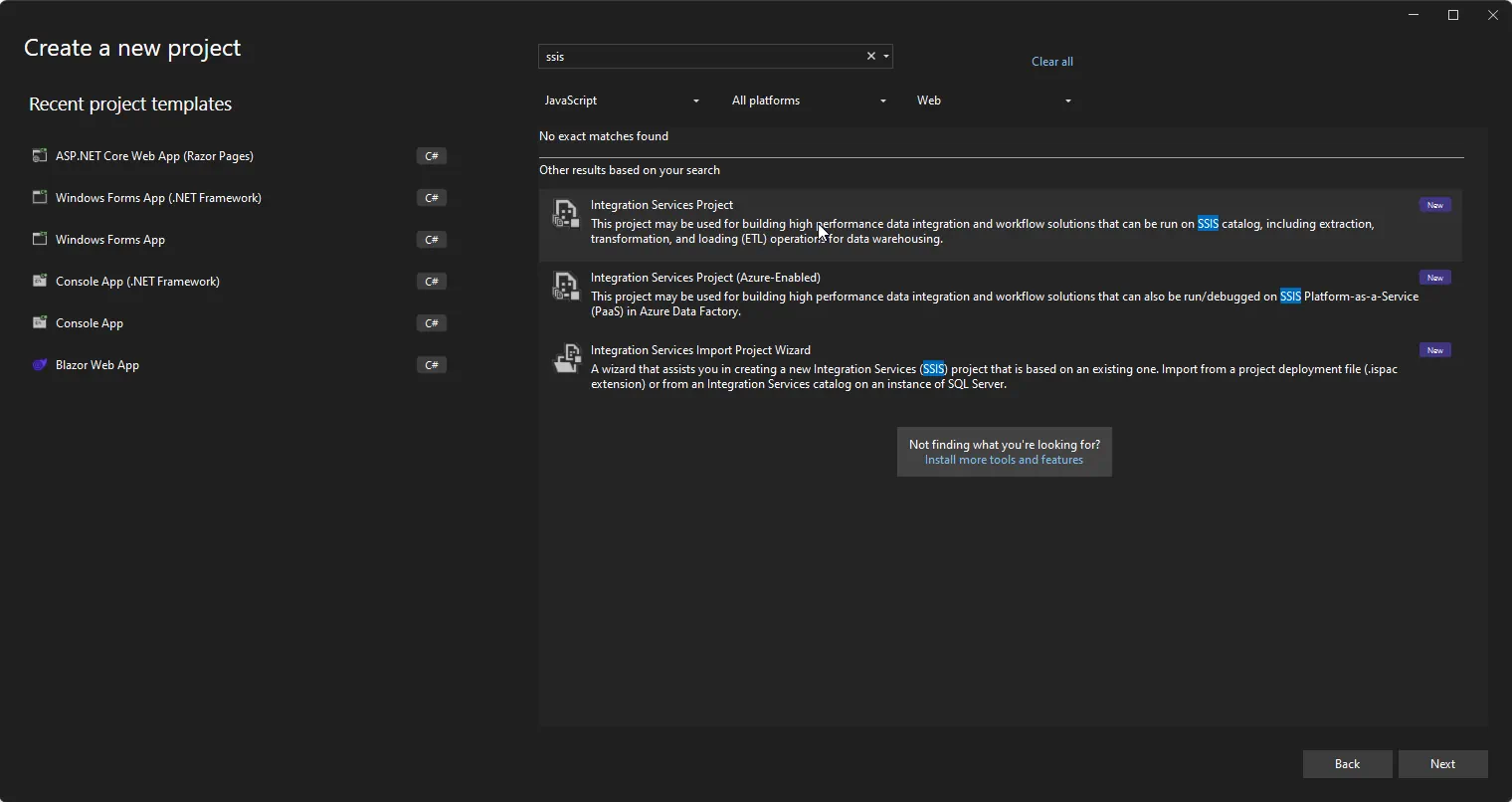
Open Visual Studio and create a new Integration Services Project.
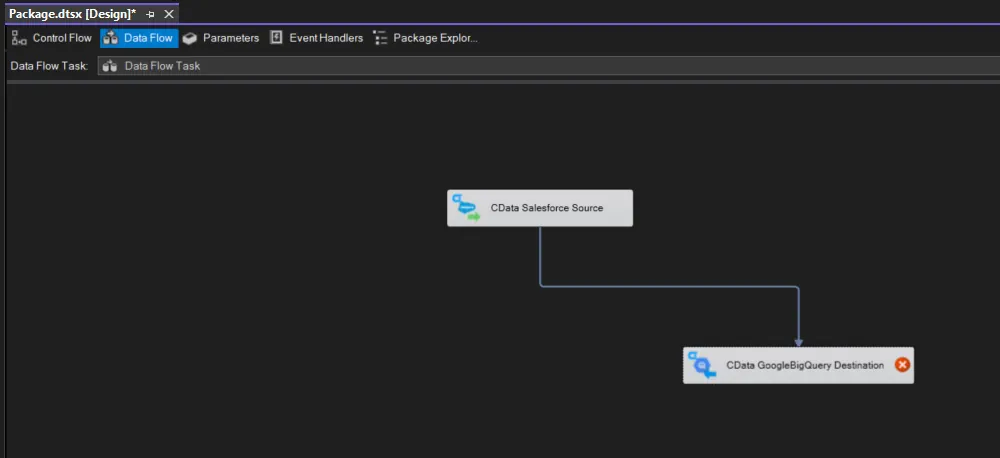
- Add a new Data Flow Task to the Control Flow screen and open the Data Flow Task.
-
Add a CData Bitbucket Source control and a CData GoogleBigQuery Destination control to the data flow task.
Configure the Bitbucket source
Follow the steps below to specify properties required to connect to Bitbucket.
-
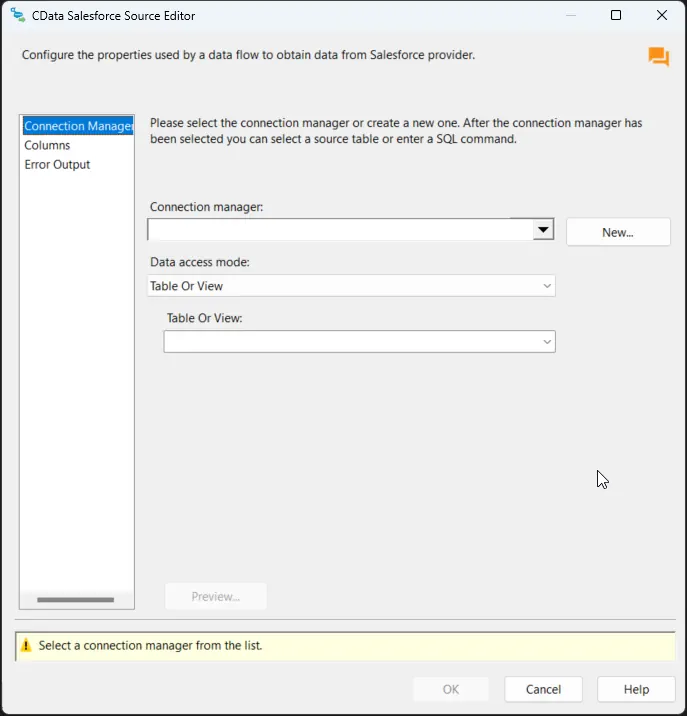
Double-click the CData Bitbucket Source to open the source component editor and add a new connection.
-
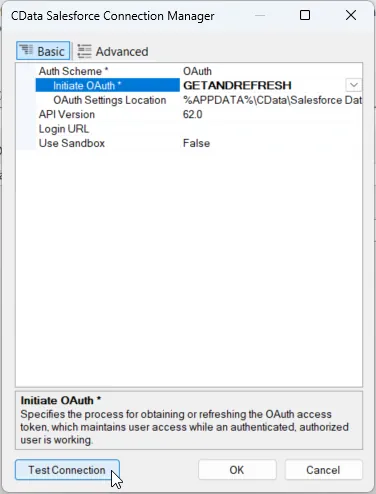
In the CData Bitbucket Connection Manager, configure the connection properties, then test and save the connection.
For most queries, you must set the Workspace. The only exception to this is the Workspaces table, which does not require this property to be set, as querying it provides a list of workspace slugs that can be used to set Workspace. To query this table, you must set Schema to 'Information' and execute the query SELECT * FROM Workspaces>.
Setting Schema to 'Information' displays general information. To connect to Bitbucket, set these parameters:
- Schema: To show general information about a workspace, such as its users, repositories, and projects, set this to Information. Otherwise, set this to the schema of the repository or project you are querying. To get a full set of available schemas, query the sys_schemas table.
- Workspace: Required if you are not querying the Workspaces table. This property is not required for querying the Workspaces table, as that query only returns a list of workspace slugs that can be used to set Workspace.
Authenticating to Bitbucket
Bitbucket supports OAuth authentication only. To enable this authentication from all OAuth flows, you must create a custom OAuth application, and set AuthScheme to OAuth.
Be sure to review the Help documentation for the required connection properties for you specific authentication needs (desktop applications, web applications, and headless machines).
Creating a custom OAuth application
From your Bitbucket account:
- Go to Settings (the gear icon) and select Workspace Settings.
- In the Apps and Features section, select OAuth Consumers.
- Click Add Consumer.
- Enter a name and description for your custom application.
- Set the callback URL:
- For desktop applications and headless machines, use http://localhost:33333 or another port number of your choice. The URI you set here becomes the CallbackURL property.
- For web applications, set the callback URL to a trusted redirect URL. This URL is the web location the user returns to with the token that verifies that your application has been granted access.
- If you plan to use client credentials to authenticate, you must select This is a private consumer. In the driver, you must set AuthScheme to client.
- Select which permissions to give your OAuth application. These determine what data you can read and write with it.
- To save the new custom application, click Save.
- After the application has been saved, you can select it to view its settings. The application's Key and Secret are displayed. Record these for future use. You will use the Key to set the OAuthClientId and the Secret to set the OAuthClientSecret.
-
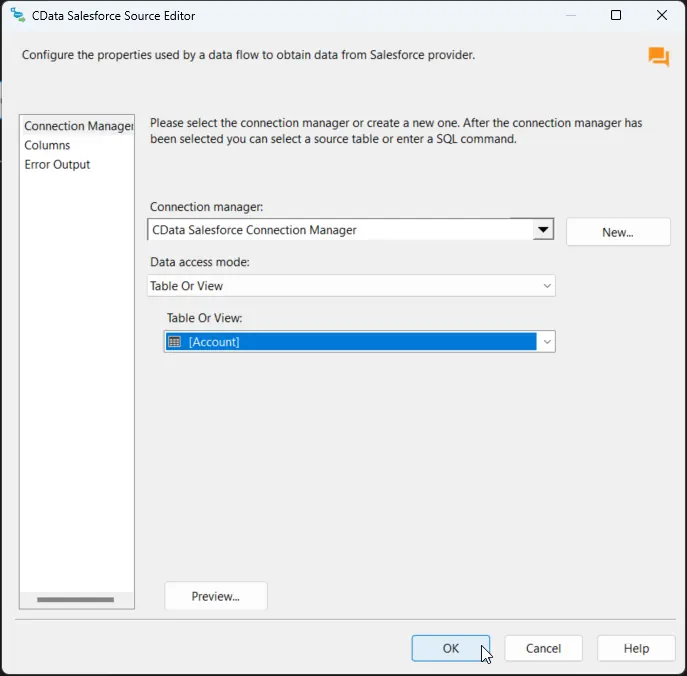
After saving the connection, select "Table or view" and select the table or view to export into Google BigQuery, then close the CData Bitbucket Source Editor.
Configure the Google BigQuery destination
With the Bitbucket Source configured, we can configure the Google BigQuery connection and map the columns.
-
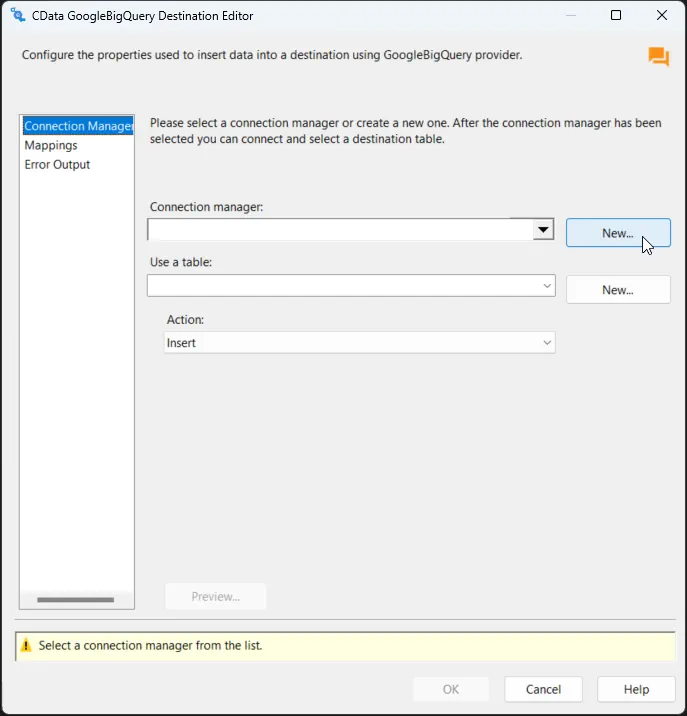
Double-click the CData Google BigQuery Destination to open the destination component editor and add a new connection.
-
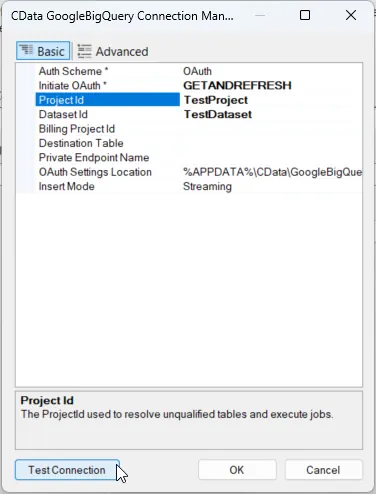
In the CData GoogleBigQuery Connection Manager, configure the connection properties, then test and save the connection.
- Google uses the OAuth authentication standard. To access Google APIs on behalf of individual users, you can use the embedded credentials or you can register your own OAuth app. OAuth also enables you to use a service account to connect on behalf of users in a Google Apps domain. To authenticate with a service account, register an application to obtain the OAuth JWT values. In addition to the OAuth values, specify the DatasetId and ProjectId. See the "Getting Started" chapter of the help documentation for a guide to using OAuth.
Helpful connection properties
- QueryPassthrough: When this is set to True, queries are passed through directly to Google BigQuery.
- ConvertDateTimetoGMT: When this is set to True, the components will convert date-time values to GMT, instead of the local time of the machine.
- FlattenObjects: By default the component reports each field in a STRUCT column as its own column while the STRUCT column itself is hidden. When this is set to False, the top-level STRUCT is not expanded and is left as its own column. The value of this column is reported as a JSON aggregate.
- SupportCaseSensitiveTables: When this property is set to true, tables with the same name but different casing will be renamed so they are all reported in the metadata. By default, the provider treats table names as case-insensitive, so if multiple tables have the same name but different casing, only one will be reported in the metadata.
-
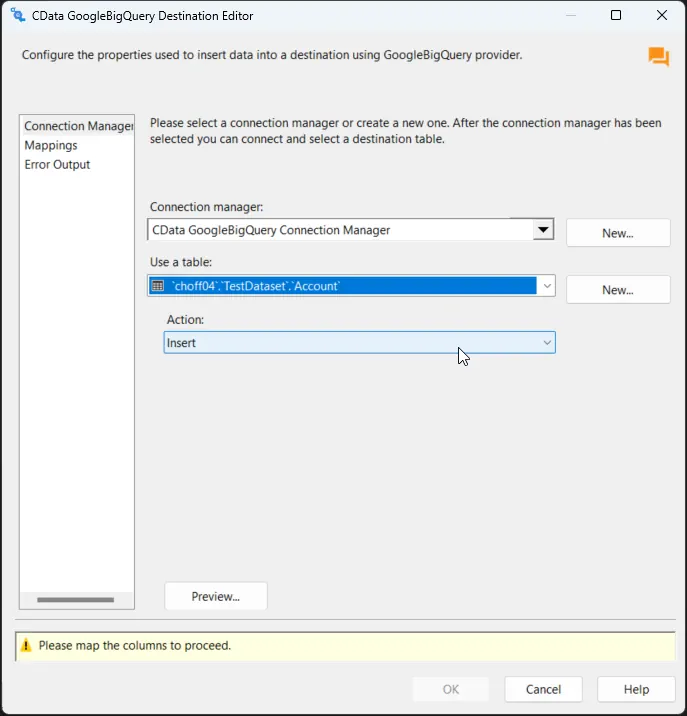
After saving the connection, select a table in the Use a Table menu and in the Action menu, select Insert.
-
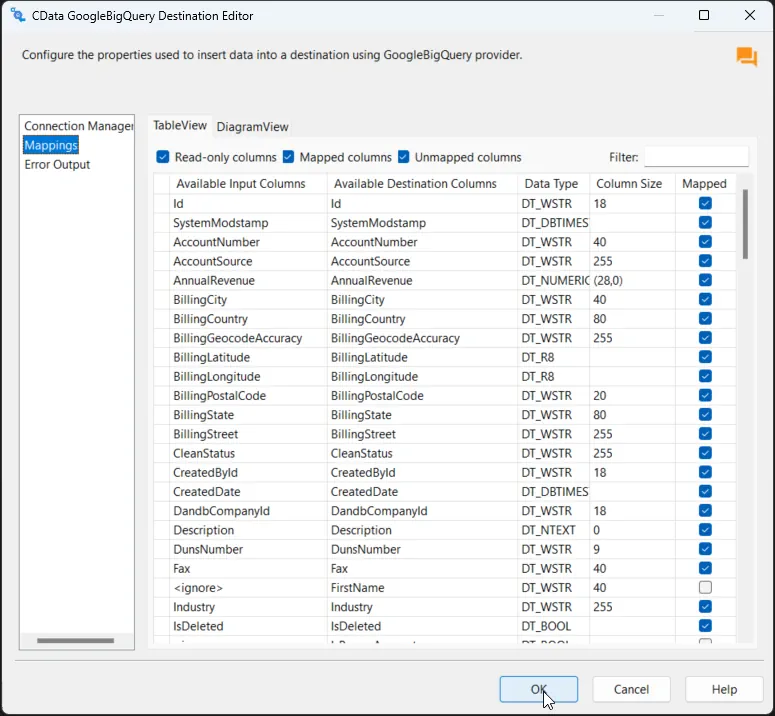
On the Column Mappings tab, configure the mappings from the input columns to the destination columns.
Run the project
You can now run the project. After the SSIS Task has finished executing, data from your SQL table will be exported to the chosen table.
Ready to get started?
Download a free trial of the Bitbucket SSIS Component to get started:
Download NowLearn more:
 Bitbucket SSIS Components
Powerful SSIS Source & Destination Components that allows you to easily connect SQL Server with Bitbucket through SSIS Workflows.
Use the Bitbucket Data Flow Components to synchronize with Bitbucket 0, and more. Perfect for data synchronization, local back-ups, workflow automation, and more!
