
Model Context Protocol (MCP) finally gives AI models a way to access the business data needed to make them really useful at work. CData MCP Servers have the depth and performance to make sure AI has access to all of the answers.
Try them now for free →


Migrating data from Certinia to Databricks using CData SSIS Components.
Easily push Certinia data to Databricks using the CData SSIS Tasks for Certinia and Databricks.
Databricks is a unified data analytics platform that allows organizations to easily process, analyze, and visualize large amounts of data. It combines data engineering, data science, and machine learning capabilities in a single platform, making it easier for teams to collaborate and derive insights from their data.
The CData SSIS Components enhance SQL Server Integration Services by enabling users to easily import and export data from various sources and destinations.
In this article, we explore the data type mapping considerations when exporting to Databricks and walk through how to migrate Certinia data to Databricks using the CData SSIS Components for Certinia and Databricks.
Data Type Mapping
| Databricks Schema | CData Schema |
|---|---|
|
int, integer, int32 |
int |
|
smallint, short, int16 |
smallint |
|
double, float, real |
float |
|
date |
date |
|
datetime, timestamp |
datetime |
|
time, timespan |
time |
|
string, varchar |
If length > 4000: nvarchar(max), Otherwise: nvarchar(length) |
|
long, int64, bigint |
bigint |
|
boolean, bool |
tinyint |
|
decimal, numeric |
decimal |
|
uuid |
nvarchar(length) |
|
binary, varbinary, longvarbinary |
binary(1000) or varbinary(max) after SQL Server 2000 |
Special Considerations
- String/VARCHAR: String columns from Databricks can map to different data types depending on the length of the column. If the column length exceeds 4000, then the column is mapped to nvarchar (max). Otherwise, the column is mapped to nvarchar (length).
- DECIMAL Databricks supports DECIMAL types up to 38 digits of precision, but any source column beyond that can cause load errors.
Prerequisites
- Visual Studio 2022
- SQL Server Integration Services Projects extension for Visual Studio 2022
- CData SSIS Components for Databricks
- CData SSIS Components for Certinia
Create the project and add components
-
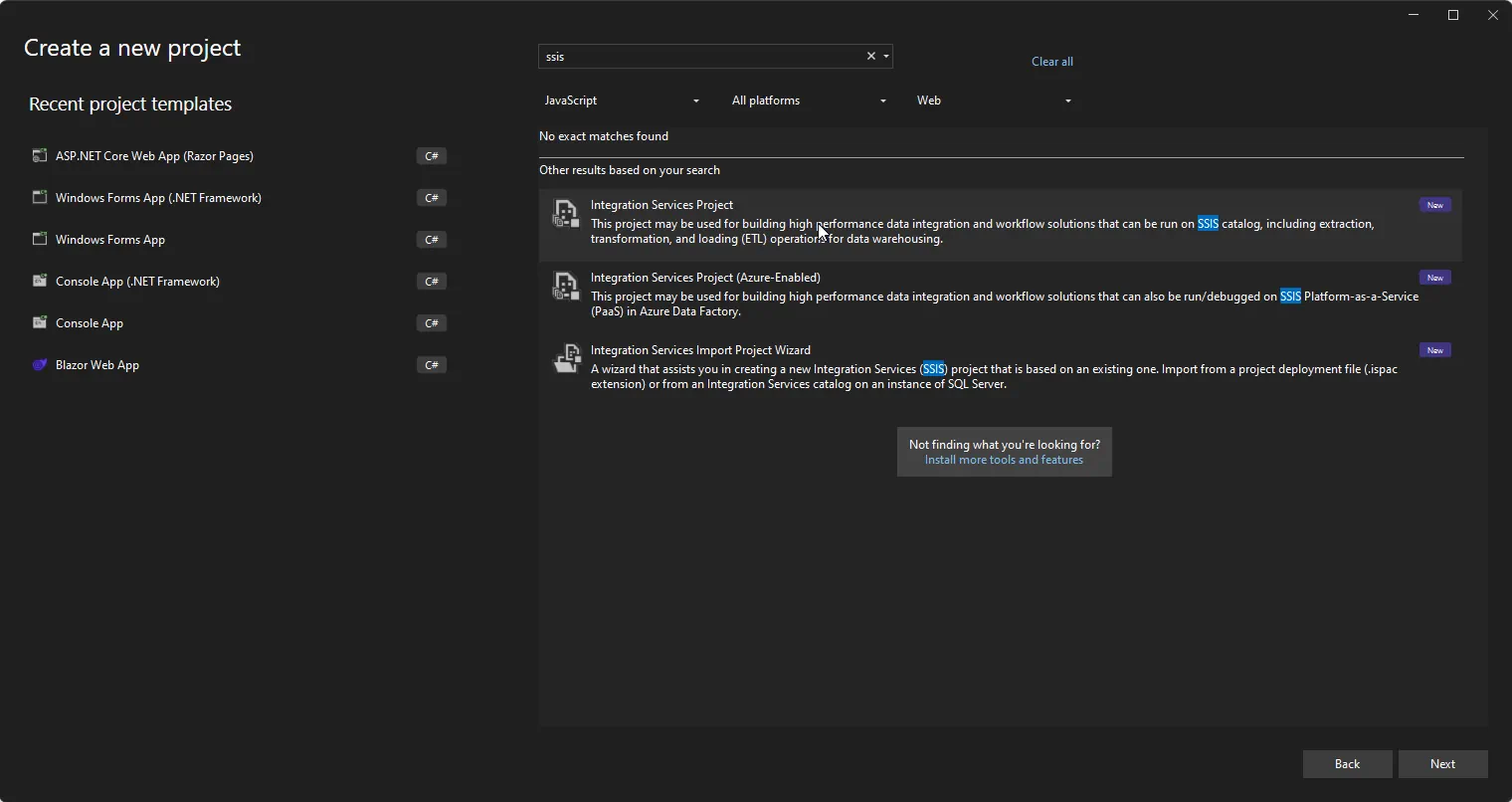
Open Visual Studio and create a new Integration Services Project.
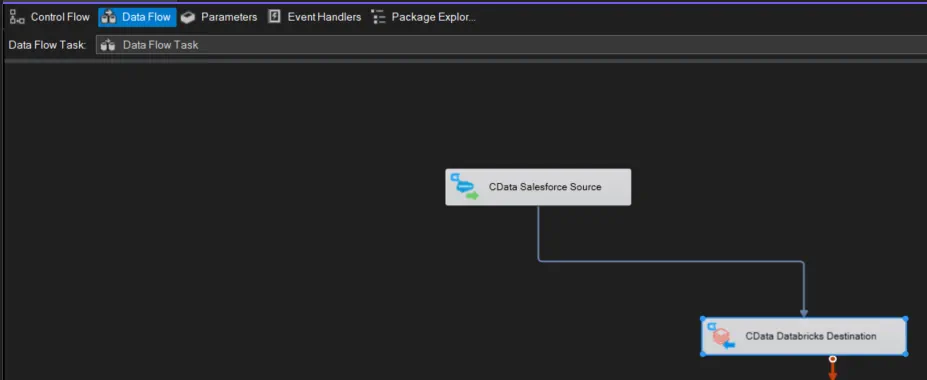
- Add a new Data Flow Task to the Control Flow screen and open the Data Flow Task.
-
Add a CData Certinia Source control and a CData Databricks Destination control to the data flow task.
Configure the Certinia source
Follow the steps below to specify properties required to connect to Certinia.
-
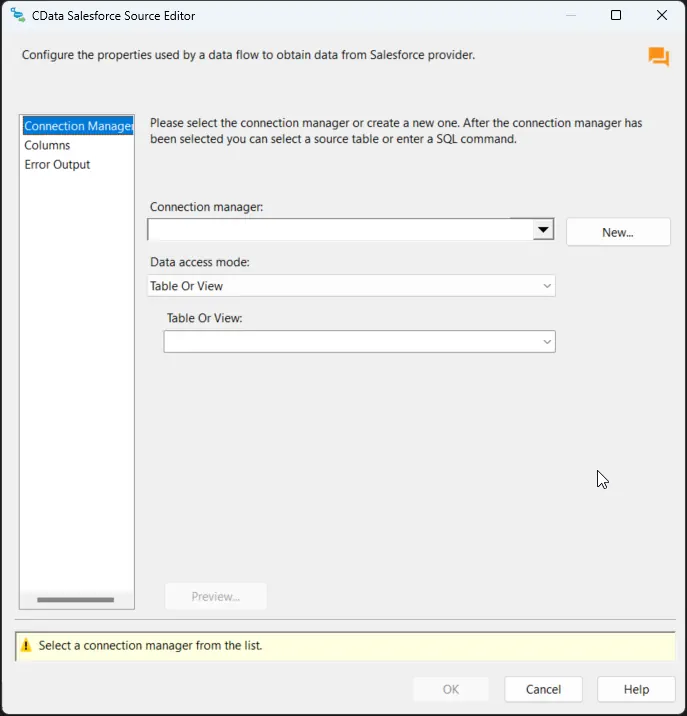
Double-click the CData Certinia Source to open the source component editor and add a new connection.
-
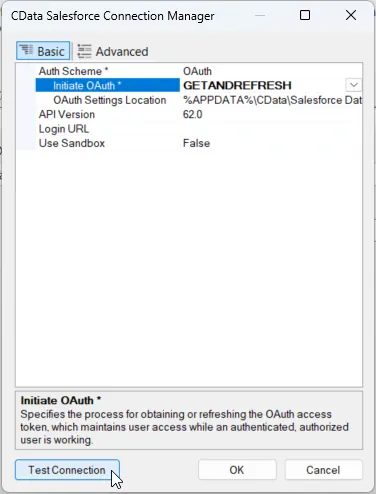
In the CData Certinia Connection Manager, configure the connection properties, then test and save the connection.
There are several authentication methods available for connecting to Certinia: login credentials, SSO, and OAuth.
Authenticating with a Login and Token
Set the User and Password to your login credentials. Additionally, set the SecurityToken. By default, the SecurityToken is required, but you can make it optional by allowing a range of trusted IP addresses.
To disable the security token:
- Log in to Certinia and enter "Network Access" in the Quick Find box in the setup section.
- Add your IP address to the list of trusted IP addresses.
To obtain the security token:
- Open the personal information page on certinia.com.
- Click the link to reset your security token. The token will be emailed to you.
- Specify the security token in the SecurityToken connection property or append it to the Password.
Authenticating with OAuth
If you do not have access to the user name and password or do not want to require them, use the OAuth user consent flow. See the OAuth section in the Help for an authentication guide.
Connecting to Certinia Sandbox Accounts
Set UseSandbox to true (false by default) to use a Certinia sandbox account. Ensure that you specify a sandbox user name in User.
-
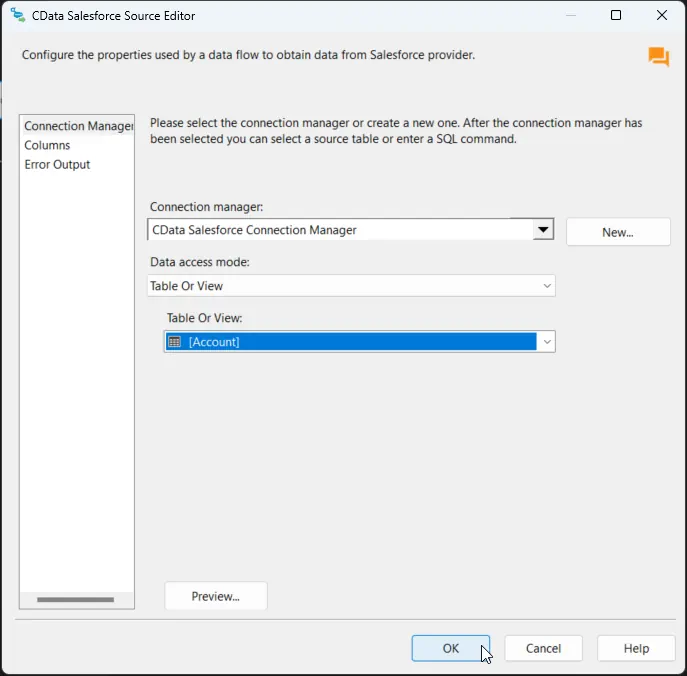
After saving the connection, select "Table or view" and select the table or view to export into Databricks, then close the CData Certinia Source Editor.
Configure the Databricks destination
With the Certinia Source configured, we can configure the Databricks connection and map the columns.
-
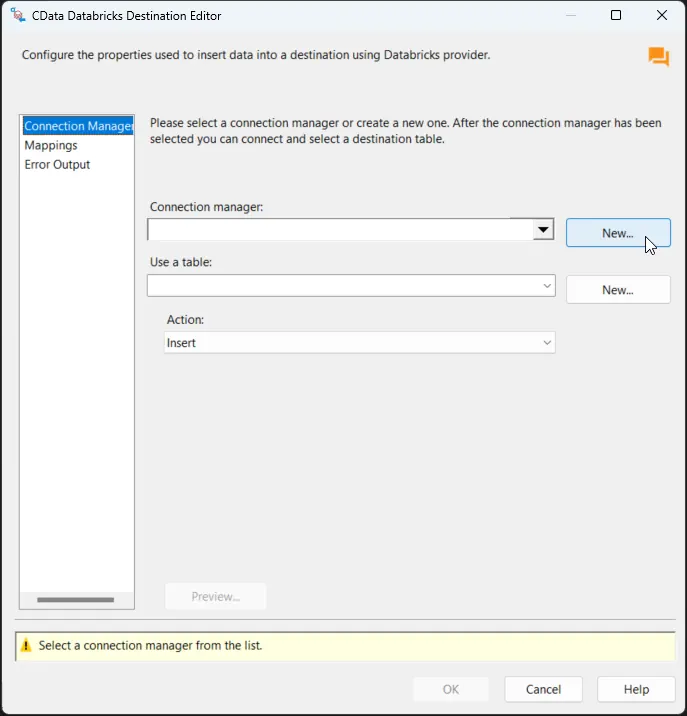
Double-click the CData Databricks Destination to open the destination component editor and add a new connection.
-
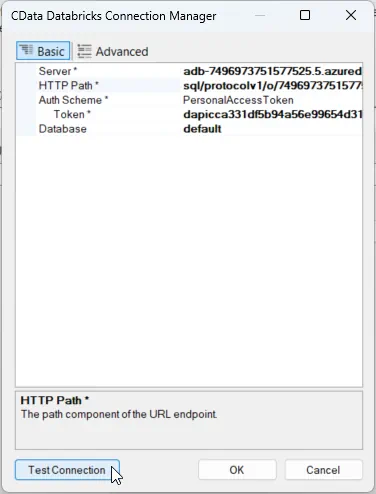
In the CData Databricks Connection Manager, configure the connection properties, then test and save the connection. To connect to a Databricks cluster, set the properties as described below.
Note: The needed values can be found in your Databricks instance by navigating to Clusters, selecting the desired cluster, and selecting the JDBC/ODBC tab under Advanced Options.
- Server: Set to the Server Hostname of your Databricks cluster.
- HTTPPath: Set to the HTTP Path of your Databricks cluster.
- Token: Set to your personal access token (this value can be obtained by navigating to the User Settings page of your Databricks instance and selecting the Access Tokens tab).
Other helpful connection properties
- QueryPassthrough: When this is set to True, queries are passed through directly to Databricks.
- ConvertDateTimetoGMT: When this is set to True, the components will convert date-time values to GMT, instead of the local time of the machine.
- UseUploadApi: Setting this property to true will improve performance if there is a large amount of data in a Bulk INSERT operation.
- UseCloudFetch: This option specifies whether to use CloudFetch to improve query efficiency when the table contains over one million entries.
-
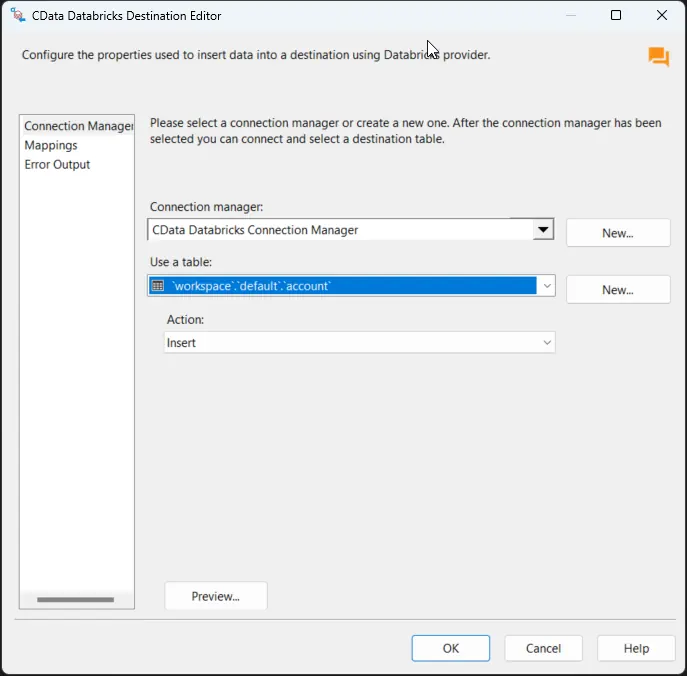
After saving the connection, select a table in the Use a Table menu and in the Action menu, select Insert.
-
On the Column Mappings tab, configure the mappings from the input columns to the destination columns.
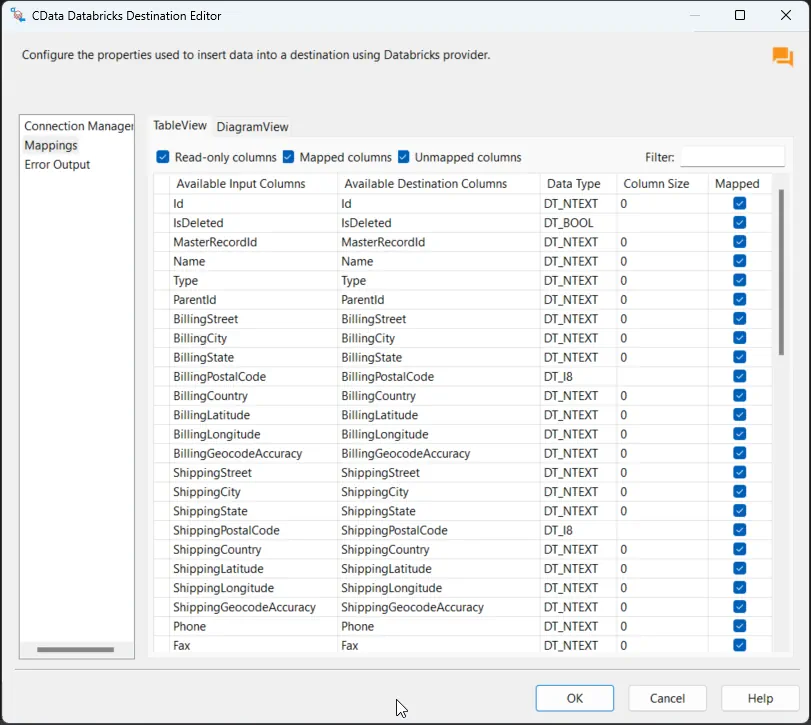
Run the project
You can now run the project. After the SSIS Task has finished executing, data from your SQL table will be exported to the chosen table.
Ready to get started?
Download a free trial of the Certinia SSIS Component to get started:
Download NowLearn more:
 Certinia SSIS Components
Powerful SSIS Source & Destination Components that allows you to easily connect SQL Server with Certinia through SSIS Workflows.
Use the Certinia Data Flow Components to synchronize with Certinia Invoices, Expenses, Accounts, and more. Perfect for data synchronization, local back-ups, workflow automation, and more!
