
Model Context Protocol (MCP) finally gives AI models a way to access the business data needed to make them really useful at work. CData MCP Servers have the depth and performance to make sure AI has access to all of the answers.
Try them now for free →


DataBind CSV Data to the DevExpress Data Grid
Use the CData ADO.NET Provider for CSV with the DevExpress Windows Forms and Web controls to provide CSV data to a chart.
The ADO.NET Provider for CSV by CData incorporates conventional ADO.NET data access components compatible with third-party controls. You can adhere to the standard ADO.NET data binding procedures to establish two-way access to real-time data through UI controls. This article will demonstrate the utilization of CData components for data binding with DevExpress UI Controls (Windows Forms and Web controls), specifically binding to a chart that visualizes live data.
The DataSource property must be set to a valid local folder name.
Also, specify the IncludeFiles property to work with text files having extensions that differ from .csv, .tab, or .txt. Specify multiple file extensions in a comma-separated list. You can also set Extended Properties compatible with the Microsoft Jet OLE DB 4.0 driver. Alternatively, you can provide the format of text files in a Schema.ini file.
Set UseRowNumbers to true if you are deleting or updating in CSV. This will create a new column with the name RowNumber which will be used as key for that table.
Windows Forms Controls
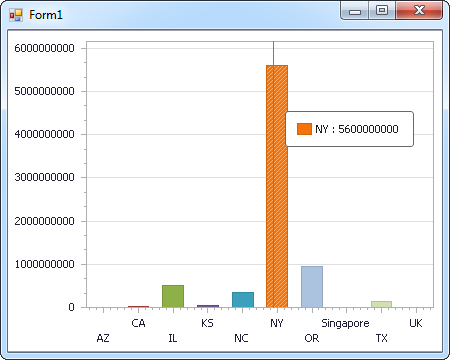
The code below shows how to populate a DevExpress chart with CSV data. The CSVDataAdapter binds to the Series property of the chart control. The Diagram property of the control defines the x- and y-axes as the column names.
using (CSVConnection connection = new CSVConnection(
"DataSource=MyCSVFilesFolder;")) {
  CSVDataAdapter dataAdapter = new CSVDataAdapter(
  "SELECT City, SUM(TotalDue) FROM Customer GROUP BY City", connection);

  DataTable table = new DataTable();
  dataAdapter.Fill(table);
  DevExpress.XtraCharts.Series series = new DevExpress.XtraCharts.Series();
  chartControl1.Series.Add(series);
  series.DataSource = table;
  series.ValueDataMembers.AddRange(new string[] { "TotalDue" });
  series.ArgumentScaleType = DevExpress.XtraCharts.ScaleType.Qualitative;
  series.ArgumentDataMember = "City";
  series.ValueScaleType = DevExpress.XtraCharts.ScaleType.Numerical;
  chartControl1.Legend.Visibility = DevExpress.Utils.DefaultBoolean.False;
  ((DevExpress.XtraCharts.SideBySideBarSeriesView)series.View).ColorEach = true;
}
Web Controls
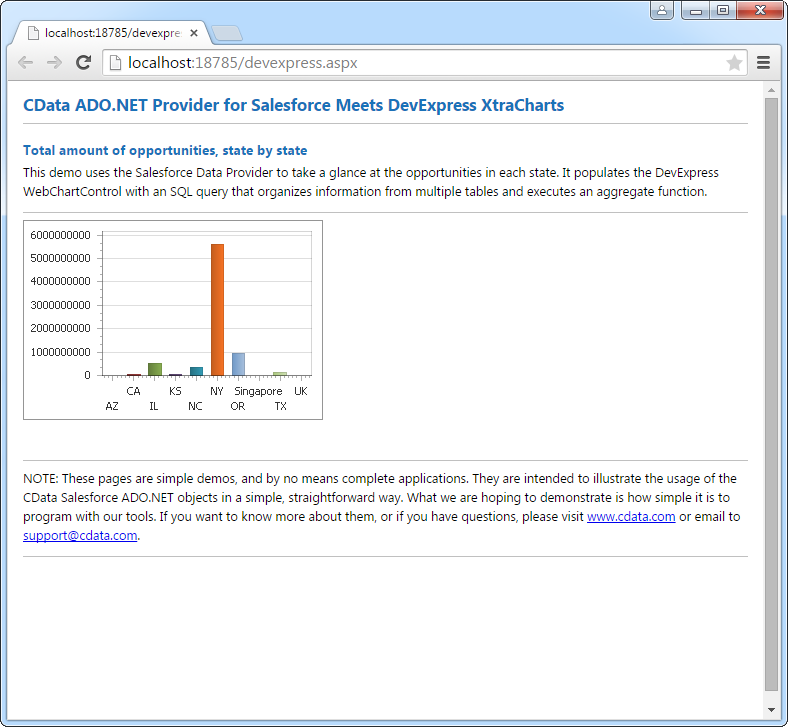
The code below shows how to populate a DevExpress Web control with CSV data. The CSVDataAdapter binds to the Series property of the chart; the Diagram property defines the x- and y-axes as the column names.
using DevExpress.XtraCharts;

using (CSVConnection connection = new CSVConnection(
"DataSource=MyCSVFilesFolder;"))
{
  CSVDataAdapter CSVDataAdapter1 = new CSVDataAdapter("SELECT City, SUM(TotalDue) FROM Customer GROUP BY City", connection);
  DataTable table = new DataTable();
  CSVDataAdapter1.Fill(table);
  DevExpress.XtraCharts.Series series = new Series("Series1", ViewType.Bar);
  WebChartControl1.Series.Add(series);
  series.DataSource = table;
  series.ValueDataMembers.AddRange(new string[] { "TotalDue" });
  series.ArgumentScaleType = ScaleType.Qualitative;
  series.ArgumentDataMember = "City";
  series.ValueScaleType = ScaleType.Numerical;
  ((DevExpress.XtraCharts.SideBySideBarSeriesView)series.View).ColorEach = true;
}
Ready to get started?
Download a free trial of the CSV Data Provider to get started:
Download NowLearn more:
 CSV ADO.NET Provider
Rapidly create and deploy powerful .NET applications that integrate with delimited flat-file (CSV/TSV) data.
