
Model Context Protocol (MCP) finally gives AI models a way to access the business data needed to make them really useful at work. CData MCP Servers have the depth and performance to make sure AI has access to all of the answers.
Try them now for free →


Configure the CData JDBC Driver for Dynamics CRM in a Connection Pool in Tomcat
Connect to Dynamics CRM data from a connection pool in Tomcat.
The CData JDBC Drivers support standard JDBC interfaces to integrate with Web applications running on the JVM. This article details how to connect to Dynamics CRM data from a connection pool in Tomcat.
About Dynamics CRM Data Integration
CData simplifies access and integration of live Microsoft Dynamics CRM data. Our customers leverage CData connectivity to:
- Read and write data in the Dynamics CRM 2011+ Services and Dynamics CRM Online.
- Extend the native features of Dynamics CRM with customizable caching and intelligent query aggregation and separation.
- Authenticate securely with Dynamics CRM in a variety of ways, including Azure Active Directory, Azure Managed Service Identity credentials, and Azure Service Principal using either a client secret or a certificate.
CData customers use our Dynamics CRM connectivity solutions for a variety of reasons, whether they're looking to replicate their data into a data warehouse (alongside other data sources) or analyze live Dynamics CRMa data from their preferred data tools inside the Microsoft ecosystem (Power BI, Excel, etc.) or with external tools (Tableau, Looker, etc.).
Getting Started
Connect to Dynamics CRM Data through a Connection Pool in Tomcat
- Copy the CData JAR and CData .lic file to $CATALINA_HOME/lib. The CData JAR is located in the lib subfolder of the installation directory.
- Add a definition of the resource to the context. Specify the JDBC URL here.
The connection string options meet the authentication and connection requirements of different Dynamics CRM instances. To connect to your instance, set the User and Password properties, under the Authentication section, to valid Dynamics CRM user credentials and set the Url to a valid Dynamics CRM server organization root. Additionally, set the CRMVersion property to 'CRM2011+' or 'CRMOnline'. IFD configurations are supported as well; set InternetFacingDeployment to true.
Additionally, you can provide the security token service (STS) or AD FS endpoint in the STSURL property. This value can be retrieved with the GetSTSUrl stored procedure. Office 365 users can connect to the default STS URL by simply setting CRMVersion.
Built-in Connection String Designer
For assistance in constructing the JDBC URL, use the connection string designer built into the Dynamics CRM JDBC Driver. Either double-click the JAR file or execute the jar file from the command-line.
java -jar cdata.jdbc.dynamicscrm.jar
Fill in the connection properties and copy the connection string to the clipboard.
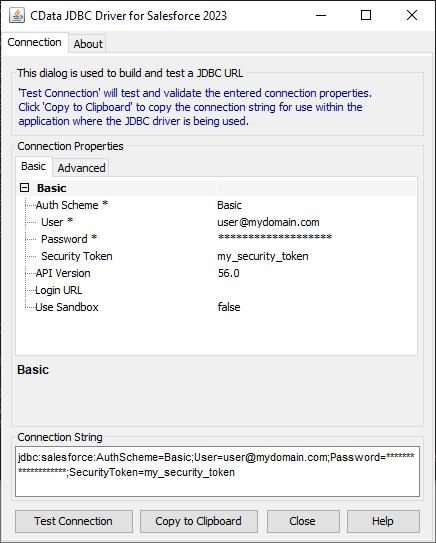
You can see the JDBC URL specified in the resource definition below.
<Resource name="jdbc/dynamicscrm" auth="Container" type="javax.sql.DataSource" driverClassName="cdata.jdbc.dynamicscrm.DynamicsCRMDriver" factory="org.apache.tomcat.jdbc.pool.DataSourceFactory" url="jdbc:dynamicscrm:User=myuseraccount;Password=mypassword;URL=https://myOrg.crm.dynamics.com/;CRM Version=CRM Online;" maxActive="20" maxIdle="10" maxWait="-1" />
To allow a single application to access Dynamics CRM data, add the code above to the context.xml in the application's META-INF directory.
For a shared resource configuration, add the code above to the context.xml located in $CATALINA_BASE/conf. A shared resource configuration provides connectivity to Dynamics CRM for all applications.
- Add a reference to the resource to the web.xml for the application.
  Dynamics CRM data JSP
  jdbc/DynamicsCRM
  javax.sql.DataSource
  Container
-
Initialize connections from the connection pool:
Context initContext = new InitialContext();
Context envContext  = (Context)initContext.lookup("java:/comp/env");
DataSource ds = (DataSource)envContext.lookup("jdbc/DynamicsCRM");
Connection conn = ds.getConnection();
More Tomcat Integration
The steps above show how to connect to Dynamics CRM data in a simple connection pooling scenario. For more use cases and information, see the JNDI Datasource How-To in the Tomcat documentation.
Ready to get started?
Download a free trial of the Dynamics CRM Driver to get started:
Download NowLearn more:
 Dynamics CRM JDBC Driver
Rapidly create and deploy powerful Java applications that integrate with Microsoft Dynamics CRM account data including Leads, Contacts, Opportunities, Accounts, and more!
