
Model Context Protocol (MCP) finally gives AI models a way to access the business data needed to make them really useful at work. CData MCP Servers have the depth and performance to make sure AI has access to all of the answers.
Try them now for free →


How to Design Sage Intacct Power Apps with Database-Like Connectivity
This article shows how to gain real-time, database-like connectivity from mobile and tablet Power Apps.
Microsoft Power Apps provides a drag and drop interface, underpinned by a rich set of formulas, for generating mobile and tablet apps that are connected to data. The CData API Server extends Power Apps with connectivity to remote data sources, without a need to maintain a separate copy of the data in the Power Apps Common Data Service. The CData API Server provides database-like connectivity for Sage Intacct, augmenting the functionality of SaaS APIs and NoSQL databases with an in-memory SQL-92 engine.
The CData API Server also supports the Swagger metadata standard, whose UI-generation and code-generation possibilities are utilized across Azure App Service, Power Automate, and Power Apps. With Swagger, Power Apps generates a complete set of formulas for working with Sage Intacct -- this article shows how to use these formulas to connect your PowerApp to remote Sage Intacct data.
About Sage Intacct Data Integration
CData provides the easiest way to access and integrate live data from Sage Intact. Customers use CData connectivity to:
- Access Sage Intacct without worrying about API updates or changes.
- Access custom objects and fields in Sage Intacct with no extra configuration steps involved.
- Write data back to Sage Intacct using embedded Web Services credentials with Basic authentication.
- Use SQL stored procedures to perform functional operations like approving or declining vendors, inserting engagements, and creating or deleting custom objects or fields.
Users frequently integrate Sage Intact with analytics tools such as Tableau, Power BI, and Excel, and leverage our tools to replicate Workday data to databases or data warehouses.
To learn about how other customers are using CData's Sage Intacct solutions, check out our blog: Drivers in Focus: Accounting Connectivity.
Getting Started
Set Up the API Server
If you have not already done so, download the CData API Server. Once you have installed the API Server, follow the steps below to begin producing secure Sage Intacct OData services:
Connect to Sage Intacct
To work with Sage Intacct data from Microsoft Power Apps, we start by creating and configuring a Sage Intacct connection. Follow the steps below to configure the API Server to connect to Sage Intacct data:
- First, navigate to the Connections page.
-
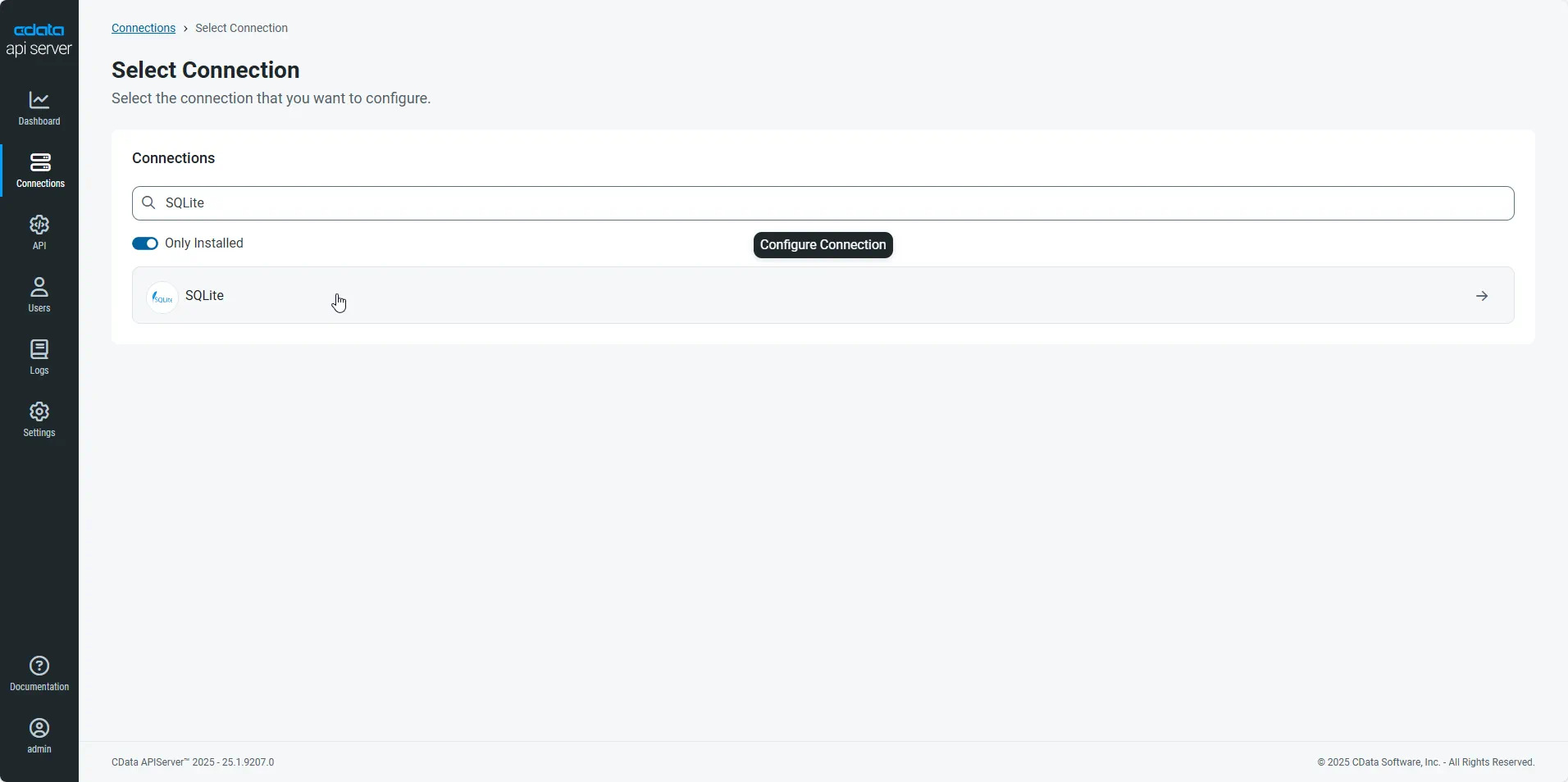
Click Add Connection and then search for and select the Sage Intacct connection.
-
Enter the necessary authentication properties to connect to Sage Intacct.
To connect using the Login method, the following connection properties are required: User, Password, CompanyId, SenderId and SenderPassword.
User, Password, and CompanyId are the credentials for the account you wish to connect to.
SenderId and SenderPassword are the Web Services credentials assigned to you by Sage Intacct.
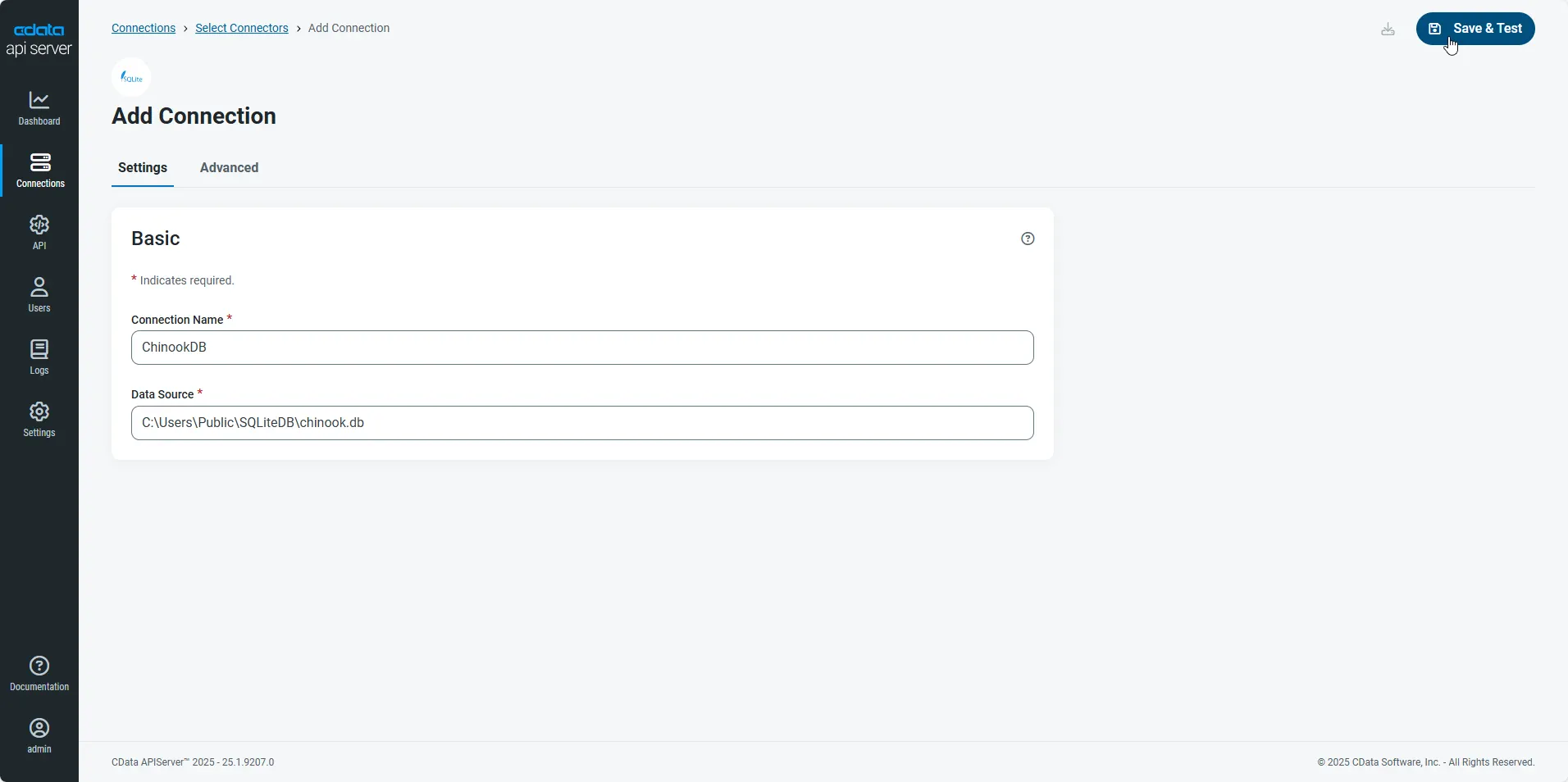
- After configuring the connection, click Save & Test to confirm a successful connection.
Configure API Server Users
Next, create a user to access your Sage Intacct data through the API Server. You can add and configure users on the Users page. Follow the steps below to configure and create a user:
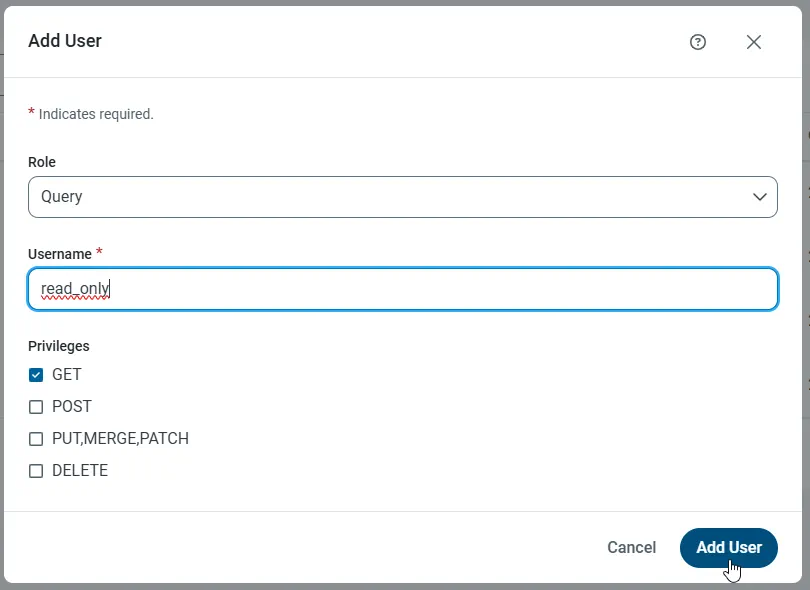
- On the Users page, click Add User to open the Add User dialog.
-
Next, set the Role, Username, and Privileges properties and then click Add User.
-
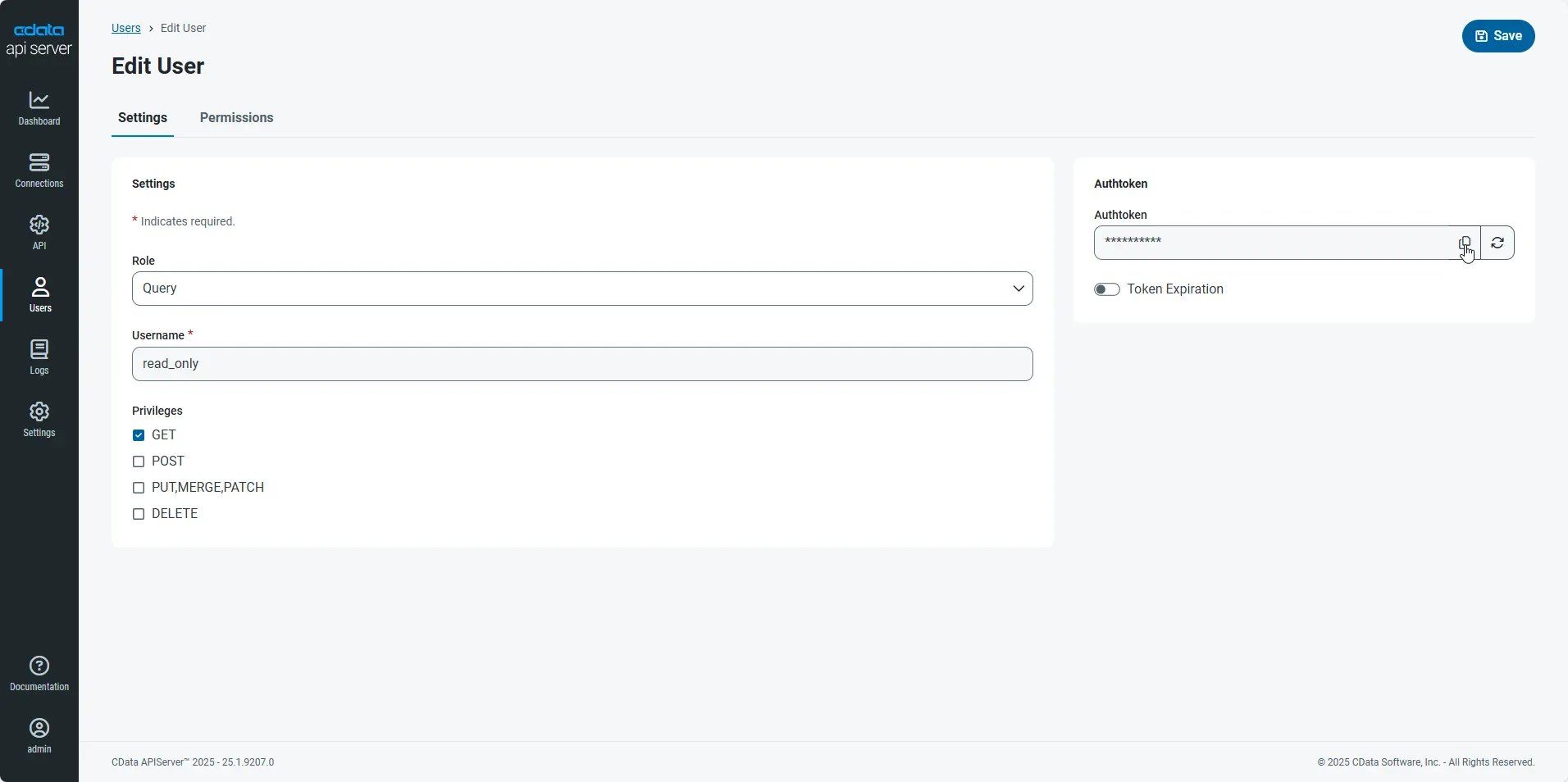
An Authtoken is then generated for the user. You can find the Authtoken and other information for each user on the Users page:
Creating API Endpoints for Sage Intacct
Having created a user, you are ready to create API endpoints for the Sage Intacct tables:
-
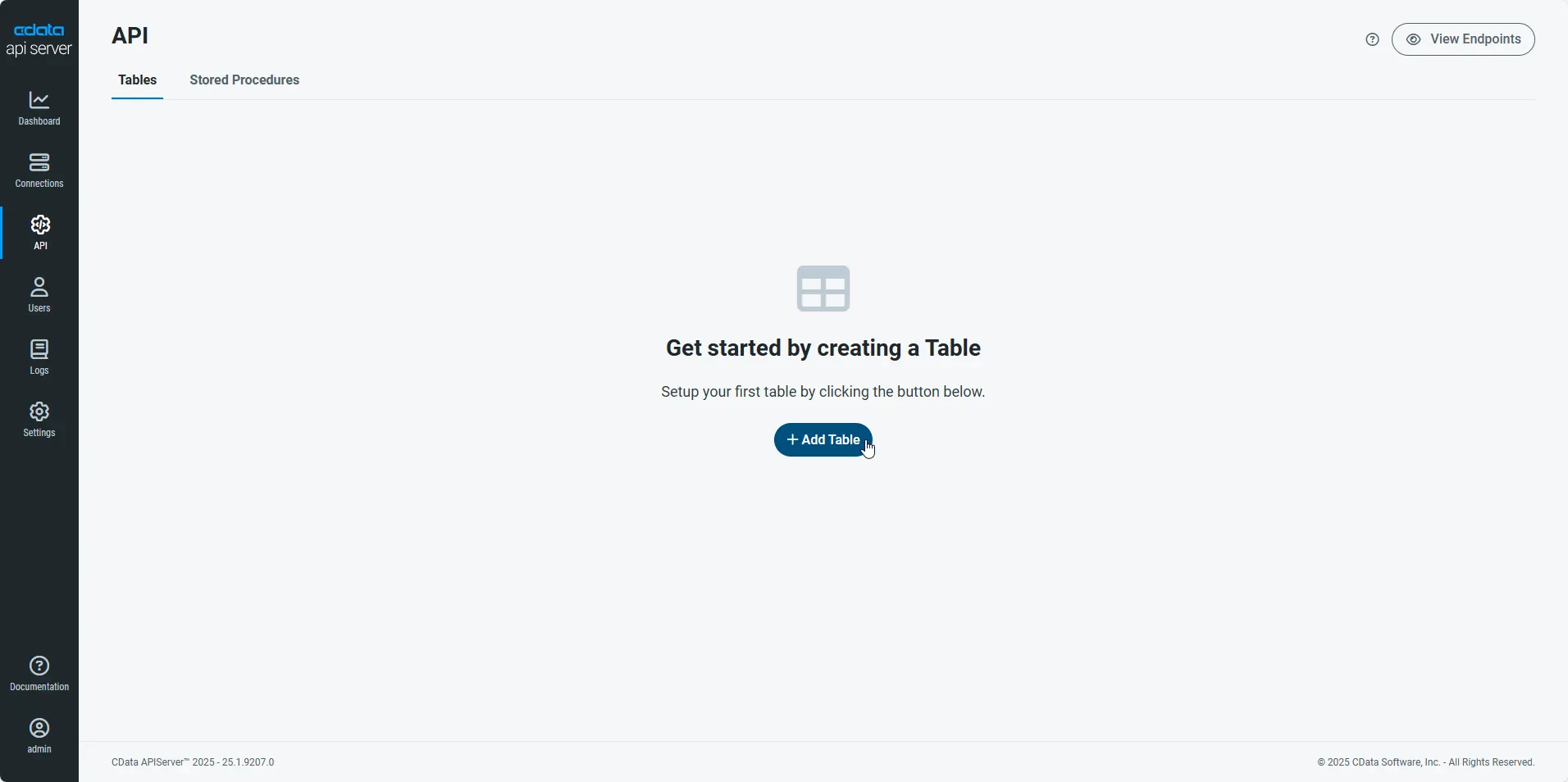
First, navigate to the API page and then click
Add Table
.
-
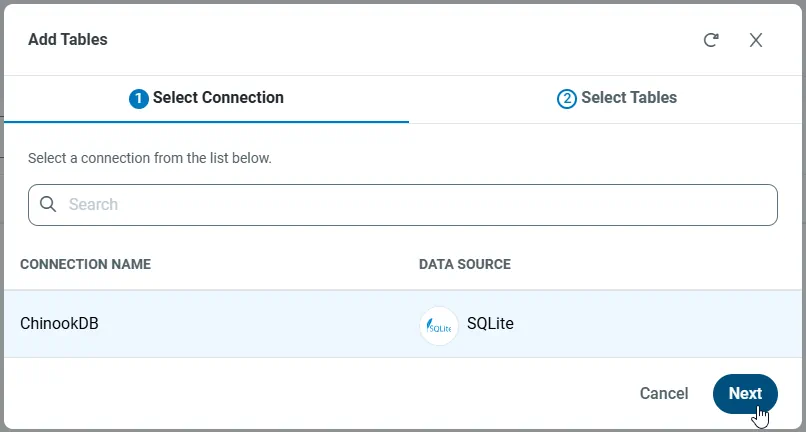
Select the connection you wish to access and click Next.
-
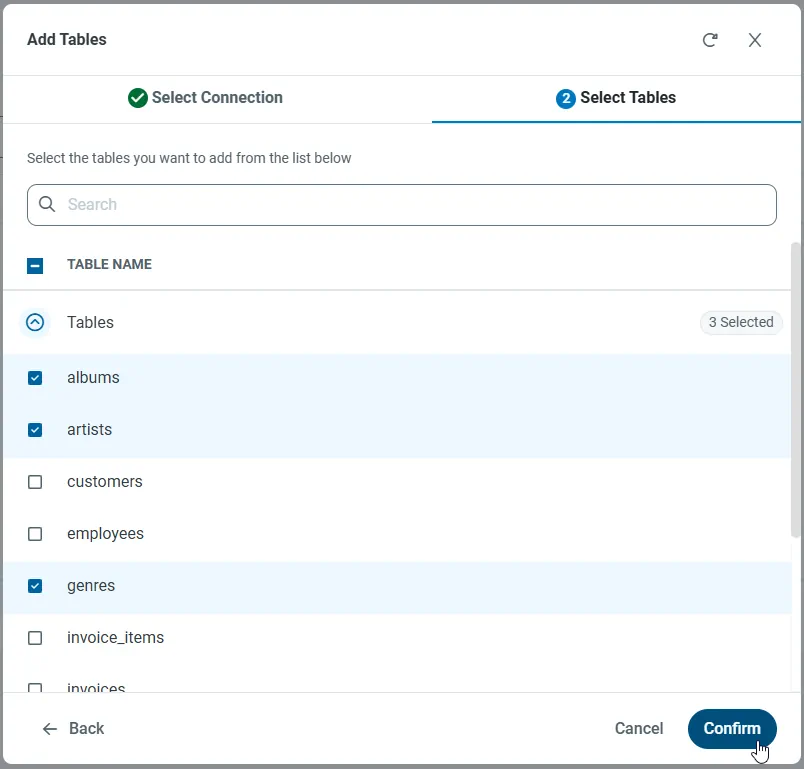
With the connection selected, create endpoints by selecting each table and then clicking Confirm.
Gather the OData Url
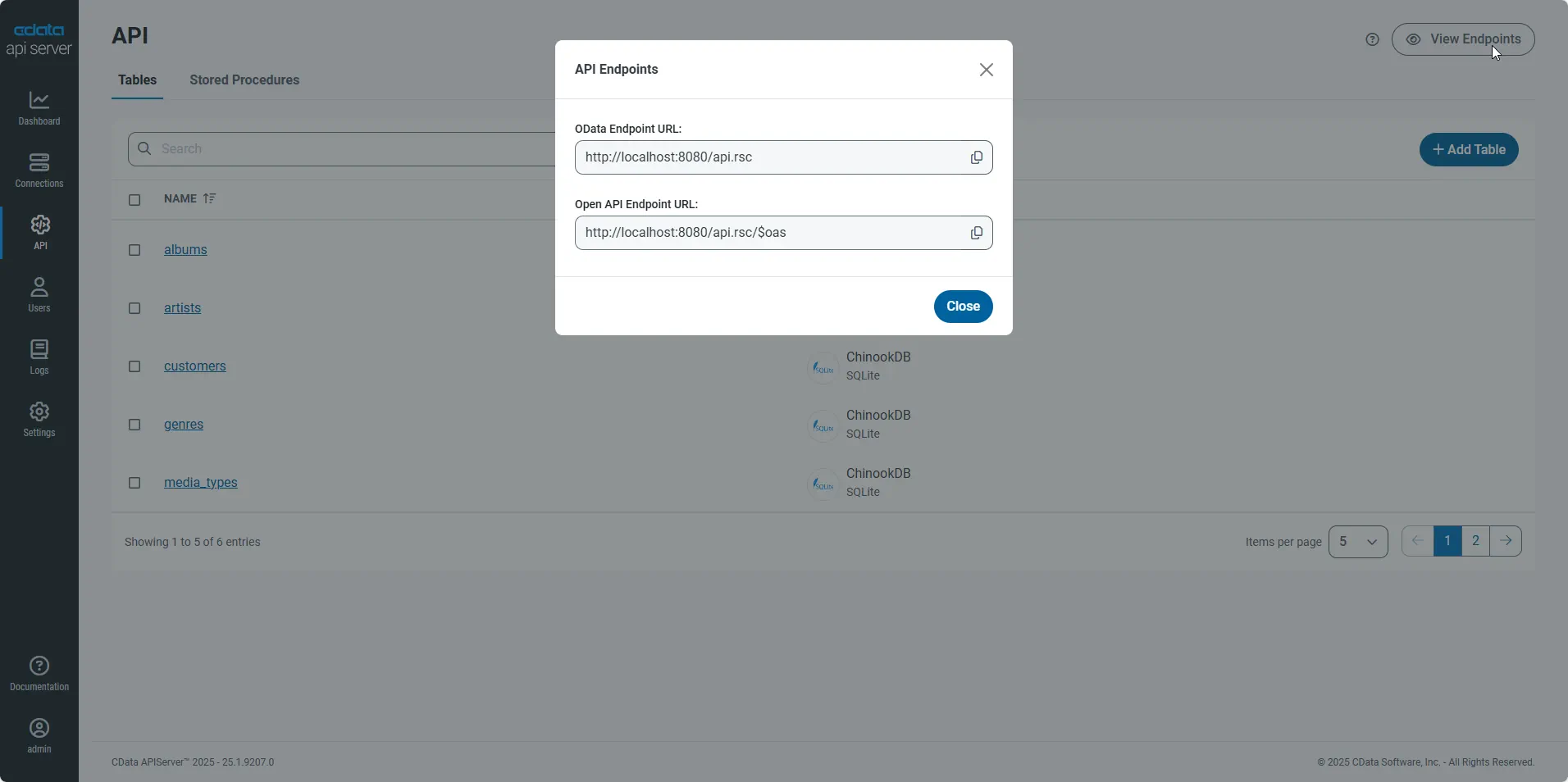
Having configured a connection to Sage Intacct data, created a user, and added resources to the API Server, you now have an easily accessible REST API based on the OData protocol for those resources. From the API page in API Server, you can view and copy the API Endpoints for the API:
Retrieve the Swagger Metadata
You will use the metadata to create a Custom API connection. You can obtain the Swagger definition by making the following request in your browser and then saving the resulting JSON file:
http://MySite:MyPort/api.rsc/$oas?version=2
Connect to API Server in Power Apps
The following procedure shows how to create a simple app that searches remote Sage Intacct data.
- In Microsoft Power Apps, click Custom connectors.
- Click Create custom connector and choose Import an OpenAPI file.
- Name the connector, browse to the JSON file, and click Continue.
- Fill in the relevant General information, ensure that Base URL is of the form /api.rsc/@myauthtoken (where myauthtoken is the AuthToken for a configure API Server user), and click Continue.
- Select No authentication for the Authentication type. Click Continue.
- Review the Action and Reference definitions and click Create connector.
- To test the connector, you will need to create a new connection. Click Test, click New Connection under Connections, and click Create.
- Navigate back to the connector from the Custom connectors menu and click Test. From here, you can test the available operations.
Connect Sage Intacct to a Power App
Follow the steps below to connect to Sage Intacct from a Power App:
- From the Power Apps main menu, click Create an app and select the on-premises or cloud Power Apps Studio.
- Select a blank app (choose Phone layout or Tablet layout).
- In the View tab, click Data Sources and click Add data source.
- Click the Connection you created to test the connector.
Populate a Gallery
Follow the steps below to create a simple app that can search Sage Intacct data. You will use Power Apps formulas to bind Sage Intacct rows to rows in a gallery control.
In the View tab, click Gallery -> Vertical to add a Gallery.
-
After selecting a gallery, assign the Items property of the gallery to Sage Intacct data on the Advanced tab of the gallery settings. The formula below will allow you to access columns in the Customer table.
ForAll(CDataSwaggerAPI.getAllCustomer().value, {myName: Name, myTotalDue: TotalDue}) -
Assign Sage Intacct columns to UI elements by clicking the element and then setting the Text property (on the Advanced tab of the UI element) to ThisItem.myName or ThisItem.myTotalDue.
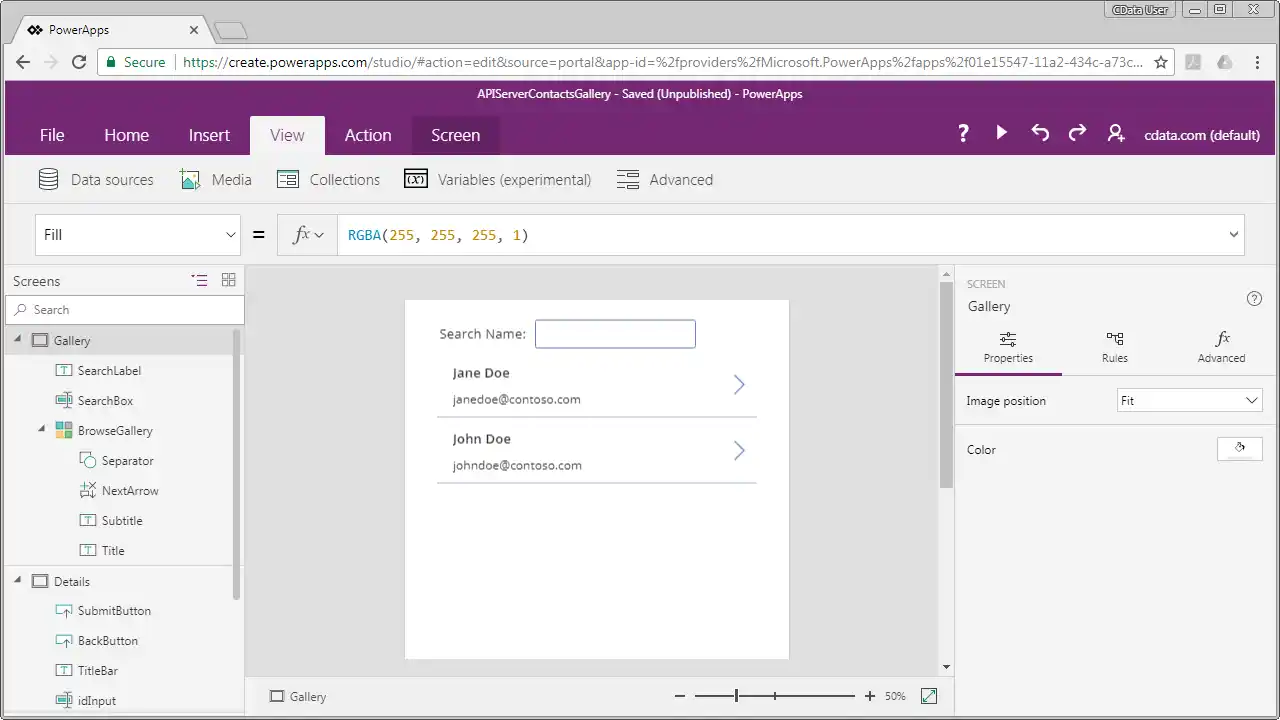
Search Sage Intacct Data
To filter the records displayed by the gallery, add a TextInput to your Screen, clear the Text property for the TextInput, and set the Items property of the gallery to a formula like the one below, replacing TextInput1 with the name of the TextInput control in your gallery, if necessary:
If(IsBlank(TextInput1.Text),
  ForAll(CDataSwaggerAPI.getAllCustomer().value, {myName: Name, myTotalDue: TotalDue}),
  ForAll(CDataSwaggerAPI.getAllCustomer({'$filter':Concatenate("contains(Name,",TextInput1.Text,")")}).value, {myName: Name, myTotalDue: TotalDue}))
The formula builds an OData query that the API Server executes against the remote Sage Intacct data, ensuring that the search is run against the current data without first pulling in every record into the app. You can find more information on the supported OData in the API Server help documentation.
Edit Sage Intacct Data
Follow the steps below to load an editable screen that shows the fields of the Sage Intacct record selected in the gallery.
- On the Insert tab, click New Screen->Blank and name the screen "Details".
- Tie the gallery to the new screen: Select the arrow button in the first entry of the gallery and in the OnSelect field in the Advanced properties, enter the following:
Navigate( Details, None )
- In the Details screen, from the Insert tab, add a label "Id" and another label for the Id value. Set the Text property to BrowseGallery.Selected.Id
For each column you will need to do the following. Note that for Custom APIs form elements cannot detect which requests need to be formulated to the API Server, so you will need to write the data modification formulas manually.
- Add a label for the field.
- Add a text input from the Text menu to the screen and set the text property to the value from the selected item from the gallery (i.e.: BrowseGallery.Selected.myName).
To give your app basic update functionality and navigation, add Submit and Back buttons:
- For the Submit button, set the OnChange property to the following:
CDataSwaggerAPI.updateCustomer(BrowseGallery.Selected.myId,BrowseGallery.Selected.myId,{Name:TextInput1.Text,TotalDue:TextInput2.Text}) - For the Back button, set the OnSelect field to the following:
Navigate( BrowseScreen, None )
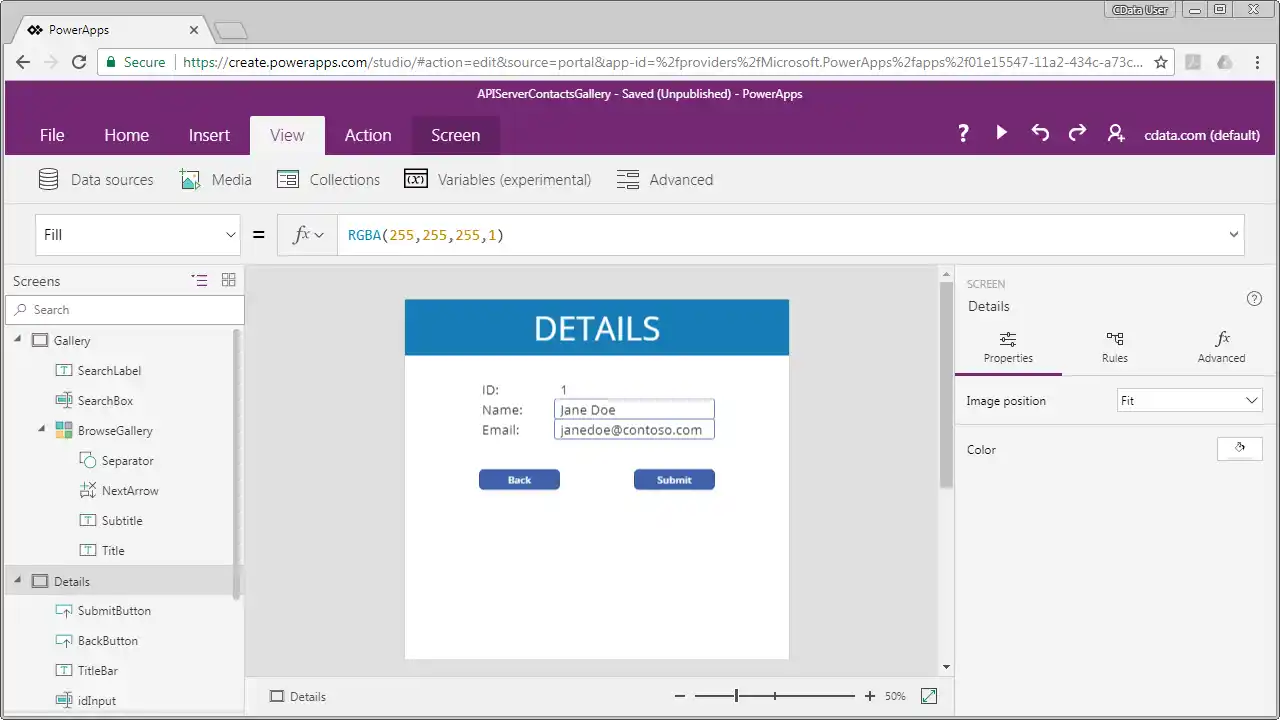
Your mobile or tablet app can now browse, search, and update Sage Intacct data.
