
Model Context Protocol (MCP) finally gives AI models a way to access the business data needed to make them really useful at work. CData MCP Servers have the depth and performance to make sure AI has access to all of the answers.
Try them now for free →


DataBind Controls to Presto Data in Delphi
DataBind to Presto data in Delphi with standard data access components and controls.
The CData ODBC driver for Presto supports the ODBC standard to enable integration of live Presto data with visual form designers and other rapid development tools in Delphi. The ODBC driver simplifies data access strategies for applications that share a single codebase like Delphi by providing a single API for database development. This article shows how to how to connect to Presto data and query data from a simple visual component library (VCL) application, as well as from Delphi code.
About Presto Data Integration
Accessing and integrating live data from Trino and Presto SQL engines has never been easier with CData. Customers rely on CData connectivity to:
- Access data from Trino v345 and above (formerly PrestoSQL) and Presto v0.242 and above (formerly PrestoDB)
- Read and write access all of the data underlying your Trino or Presto instances
- Optimized query generation for maximum throughput.
Presto and Trino allow users to access a variety of underlying data sources through a single endpoint. When paired with CData connectivity, users get pure, SQL-92 access to their instances, allowing them to integrate business data with a data warehouse or easily access live data directly from their preferred tools, like Power BI and Tableau.
In many cases, CData's live connectivity surpasses the native import functionality available in tools. One customer was unable to effectively use Power BI due to the size of the datasets needed for reporting. When the company implemented the CData Power BI Connector for Presto they were able to generate reports in real-time using the DirectQuery connection mode.
Getting Started
Create a Connection to Presto Data
If you have not already, first specify connection properties in an ODBC DSN (data source name). This is the last step of the driver installation. You can use the Microsoft ODBC Data Source Administrator to create and configure ODBC DSNs.
Set the Server and Port connection properties to connect, in addition to any authentication properties that may be required.
To enable TLS/SSL, set UseSSL to true.
Authenticating with LDAP
In order to authenticate with LDAP, set the following connection properties:
- AuthScheme: Set this to LDAP.
- User: The username being authenticated with in LDAP.
- Password: The password associated with the User you are authenticating against LDAP with.
Authenticating with Kerberos
In order to authenticate with KERBEROS, set the following connection properties:
- AuthScheme: Set this to KERBEROS.
- KerberosKDC: The Kerberos Key Distribution Center (KDC) service used to authenticate the user.
- KerberosRealm: The Kerberos Realm used to authenticate the user with.
- KerberosSPN: The Service Principal Name for the Kerberos Domain Controller.
- KerberosKeytabFile: The Keytab file containing your pairs of Kerberos principals and encrypted keys.
- User: The user who is authenticating to Kerberos.
- Password: The password used to authenticate to Kerberos.
You can then follow the steps below to use the Data Explorer to create a FireDAC connection to Presto data.
- In a new VCL Forms application, expand the FireDAC node in the Data Explorer.
- Right-click the ODBC Data Source node in the Data Explorer.
- Click Add New Connection.
- Enter a name for the connection.
- In the FireDAC Connection Editor that appears, set the DataSource property to the name of the ODBC DSN for Presto.
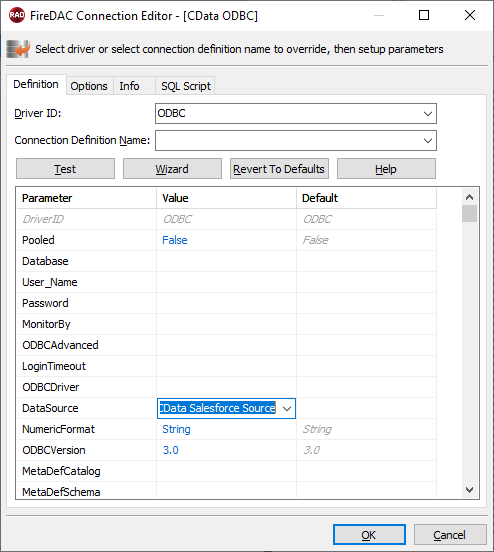
Create VCL Applications with Connectivity to Presto Data
Follow the procedure below to start executing queries to Presto data from a simple VCL application that displays the results of a query in a grid.
-
Drop a TFDConnection component onto the form and set the following properties:
- ConnectionDefName: Select the FireDAC connection to Presto data.
- Connected: Select True from the menu and, in the dialog that appears, enter your credentials.
-
Drop a TFDQuery component onto the form and set the properties below:
- Connection: Set this property to the TFDConnection component, if this component is not already specified.
SQL: Click the button in the SQL property and enter a query. For example:
SELECT FirstName, LastName FROM Customer WHERE Id = '123456789'
- Active: Set this property to true.
Drop a TDataSource component onto the form and set the following property:
- DataSet: In the menu for this property, select the name of the TFDQuery component.
-
Drop a TDBGrid control onto the form and set the following property:
- DataSource: Select the name of the TDataSource.
- Drop a TFDGUIxWaitCursor onto the form — this is required to avoid a run-time error.
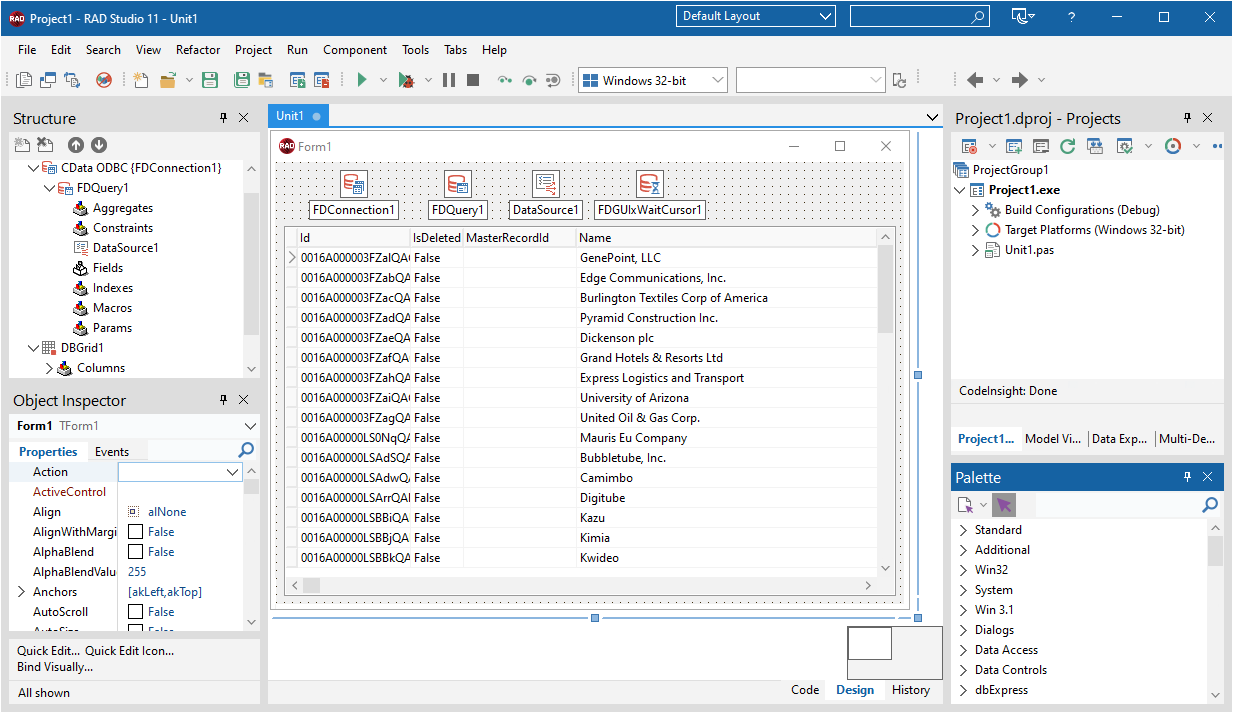
Execute Commands to Presto with FireDAC Components
You can use the TFDConnection and TFQuery components to execute queries to Presto data. This section provides Presto data-specific examples of executing queries with the TFQuery component.
Connect to Presto Data
To connect to the data source, set the Connected property of the TFDConnection component to true. You can set the same properties from code:
FDConnection1.ConnectionDefName := 'mypresto';
FDConnection1.Connected := true;
Create Parameterized Queries
Parameterized resources can improve performance: Preparing statements is costly in system resources and time. The connection must be active and open while a statement is prepared. By default, FireDAC prepares the query to avoid recompiling the same query over and over. To disable statement preparation, set ResourceOptions.DirectExecute to True; for example, when you need to execute a query only once.
Execute a Query
To execute a query that returns a result set, such as a select query, use the Open method. The Open method executes the query, returns the result set, and opens it. The Open method will return an error if the query does not produce a result set.
FDQuery1.Open('select * from Customer where Id = :Id',['123456789']);
To execute a query that does not return a result set, such as a delete, use the ExecSQL method. The ExecSQL method will return an error if the query returns a result set. To retrieve the count of affected rows, use the TFD.RowsAffected property.
FDQuery1.ExecSQL('delete from Customer where Id= :myId',['x12345']);
i := FDQuery1.RowsAffected;
Related Articles
Below you can find other articles for using the CData ODBC Driver with RAD Studio, Delphi, and C++ Builder.
Ready to get started?
Download a free trial of the Presto ODBC Driver to get started:
Download NowLearn more:
 Presto ODBC Driver
The Presto ODBC Driver is a powerful tool that allows you to connect with live data from Presto, directly from any applications that support ODBC connectivity.
Access Presto data like you would a database - read, write, and update Presto Tables, etc. through a standard ODBC Driver interface.
