
Model Context Protocol (MCP) finally gives AI models a way to access the business data needed to make them really useful at work. CData MCP Servers have the depth and performance to make sure AI has access to all of the answers.
Try them now for free →


Migrating data from SAP Ariba Procurement to Snowflake using CData SSIS Components.
Easily push SAP Ariba Procurement data to Snowflake using the CData SSIS Tasks for SAP Ariba Procurement and Snowflake.
Snowflake is a leading cloud data warehouse and a popular backbone for enterprise BI, analytics, data management, and governance initiatives. Snowflake offers features such as data sharing, real-time data processing, and secure data storage which makes it a common choice for cloud data consolidation.
The CData SSIS Components enhance SQL Server Integration Services by enabling users to easily import and export data from various sources and destinations.
In this article, we explore the data type mapping considerations when exporting to Snowflake and walk through how to migrate SAP Ariba Procurement data to Snowflake using the CData SSIS Components for SAP Ariba Procurement and Snowflake.
Data Type Mapping
| Snowflake Schema | CData Schema |
|---|---|
|
NUMBER, DECIMAL, NUMERIC, INT, INTEGER, BIGINT, SMALLINT, TINYINT, BYTEINT |
decimal |
|
DOUBLE, FLOAT, FLOAT4, FLOAT8, DOUBLEPRECISION, REAL |
real |
|
VARCHAR, CHAR, STRING, TEXT, VARIANT, OBJECT, ARRAY, GEOGRAPHY |
varchar |
|
BINARY, VARBINARY |
binary |
|
BOOLEAN |
bool |
|
DATE |
date |
|
DATETIME, TIMESTAMP, TIMESTAMP_LTZ, TIMESTAMP_NTZ, TIMESTAMP_TZ |
datetime |
|
TIME |
time |
Special Considerations
- Casing: Snowflake enforces an exact case match by default for identifiers, so it is common to run into issues that can be attributed to mismatched casing. Set the IgnoreCase property to True in your CData SSIS Components for Snowflake connection to resolve these issues. This property directly maps to the QUOTED_IDENTIFIERS_IGNORE_CASE property in Snowflake and specifies whether Snowflake will treat identifiers as case-sensitive.
-
Timestamps: Snowflake supports three timestamp types:
- TIMESTAMP_NTZ: This timestamp stores UTC time with a specified precision. However, all operations are performed in the current session's time zone, controlled by the TIMEZONE session parameter.
- TIMESTAMP_LTZ: This timestamp stores "wallclock" time with a specified precision. All operations are performed without taking any time zone into account.
- TIMESTAMP_TZ: This timestamp stores UTC time together with an associated time zone offset. When a time zone isn't provided, the session time zone offset is used.
By default the CData SSIS Components write timestamps to Snowflake as TIMESTAMP_NTZ unless manually configured.
Prerequisites
- Visual Studio 2022
- SQL Server Integration Services Projects extension for Visual Studio 2022
- CData SSIS Components for Snowflake
- CData SSIS Components for SAP Ariba Procurement
Create the project and add components
-
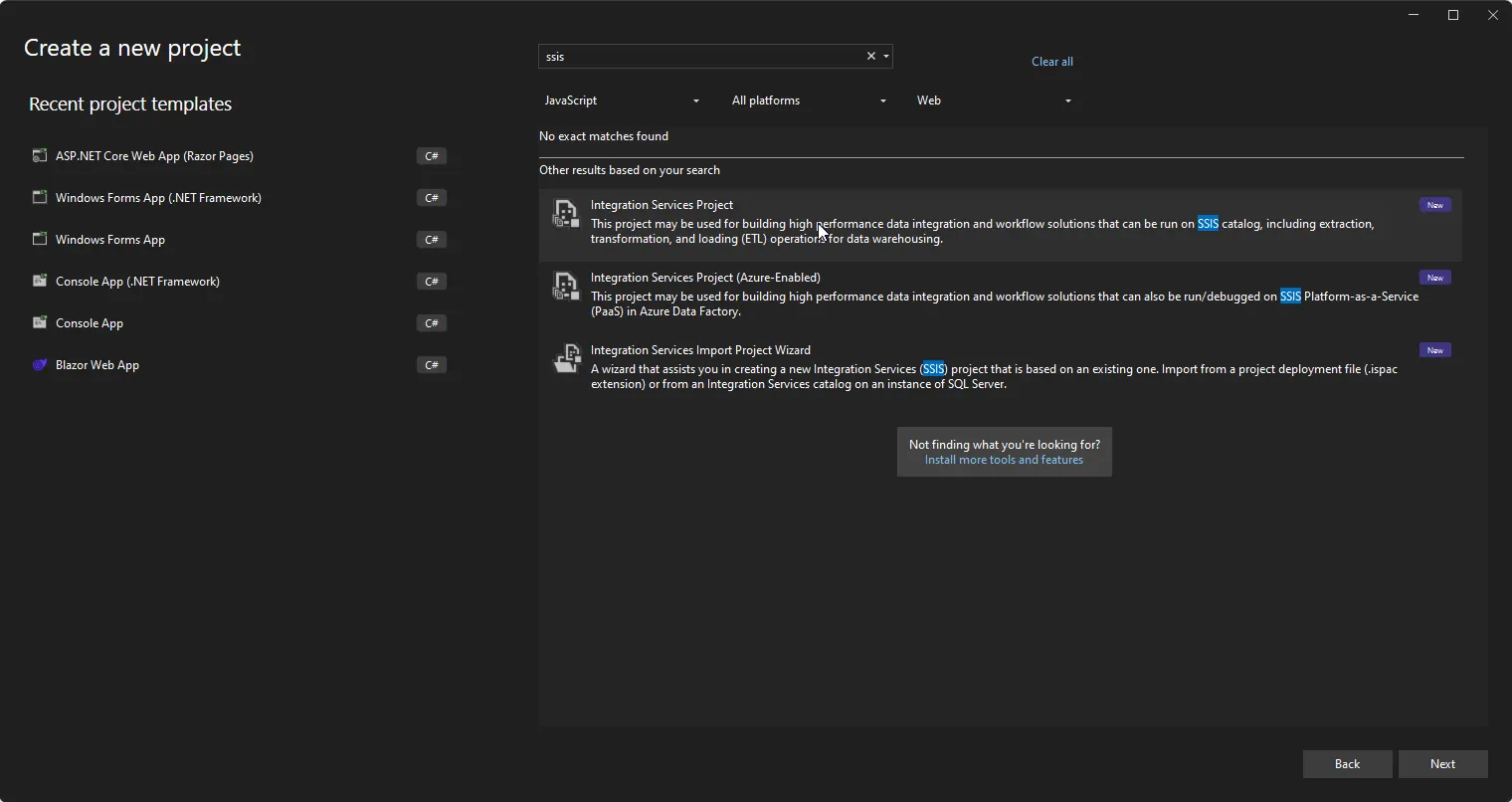
Open Visual Studio and create a new Integration Services Project.
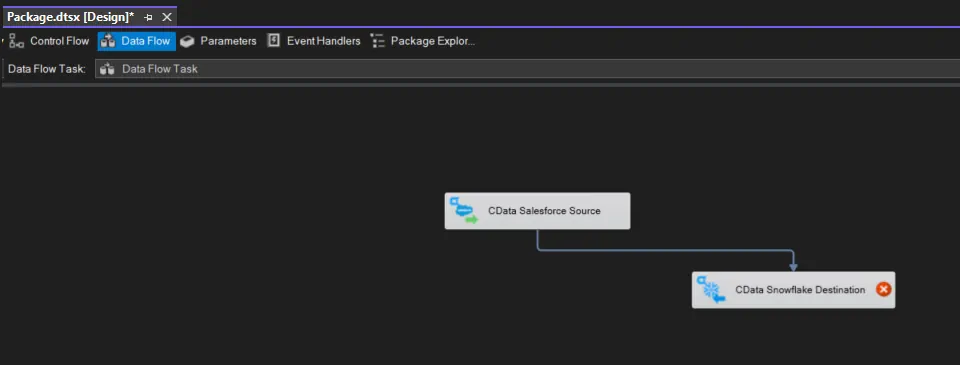
- Add a new Data Flow Task to the Control Flow screen and open the Data Flow Task.
-
Add a CData SAP Ariba Procurement Source control and a CData Snowflake Destination control to the data flow task.
Configure the SAP Ariba Procurement source
Follow the steps below to specify properties required to connect to SAP Ariba Procurement.
-
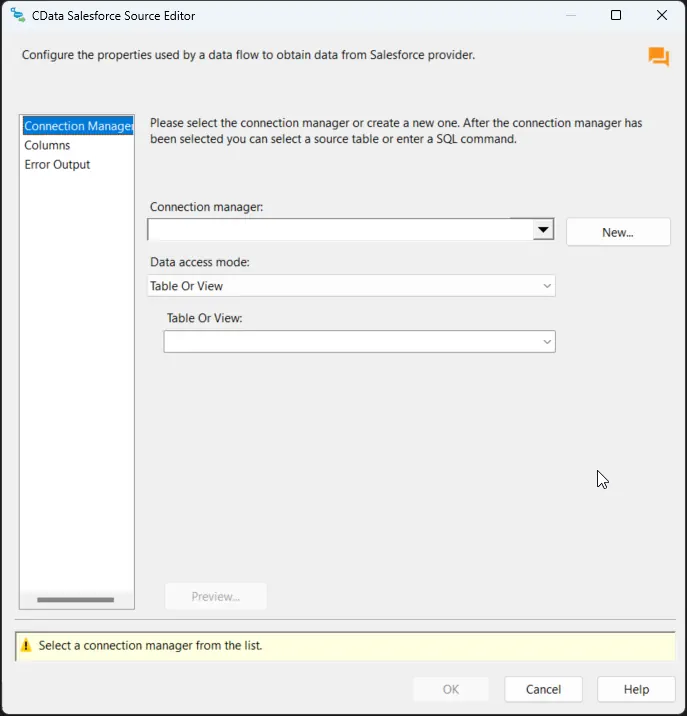
Double-click the CData SAP Ariba Procurement Source to open the source component editor and add a new connection.
-
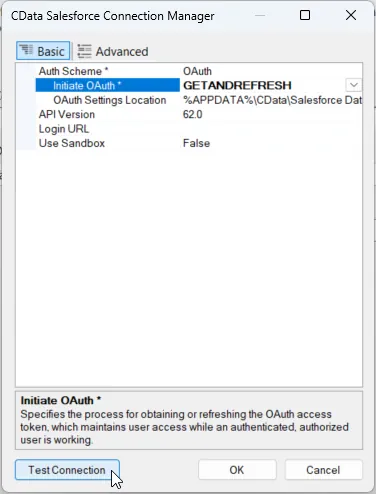
In the CData SAP Ariba Procurement Connection Manager, configure the connection properties, then test and save the connection.
In order to connect with SAP Ariba Procurement, set the following:
- ANID: Your Ariba Network ID.
- ANID: Specify which API you would like the provider to retrieve SAP Ariba data from. Select the Buyer or Supplier API based on your business role (possible values are PurchaseOrdersBuyerAPIV1 or PurchaseOrdersSupplierAPIV1).
- Environment: Indicate whether you are connecting to a test or production environment (possible values are TEST or PRODUCTION).
Authenticating with OAuth
After setting connection properties, you need to configure OAuth connectivity to authenticate.
- Set AuthScheme to OAuthClient.
- Register an application with the service to obtain the APIKey, OAuthClientId and OAuthClientSecret.
For more information on creating an OAuth application, refer to the Help documentation.
Automatic OAuth
After setting the following, you are ready to connect:
-
APIKey: The Application key in your app settings.
OAuthClientId: The OAuth Client Id in your app settings.
OAuthClientSecret: The OAuth Secret in your app settings.
When you connect, the provider automatically completes the OAuth process:
- The provider obtains an access token from SAP Ariba and uses it to request data.
- The provider refreshes the access token automatically when it expires.
- The OAuth values are saved in memory relative to the location specified in OAuthSettingsLocation.
-
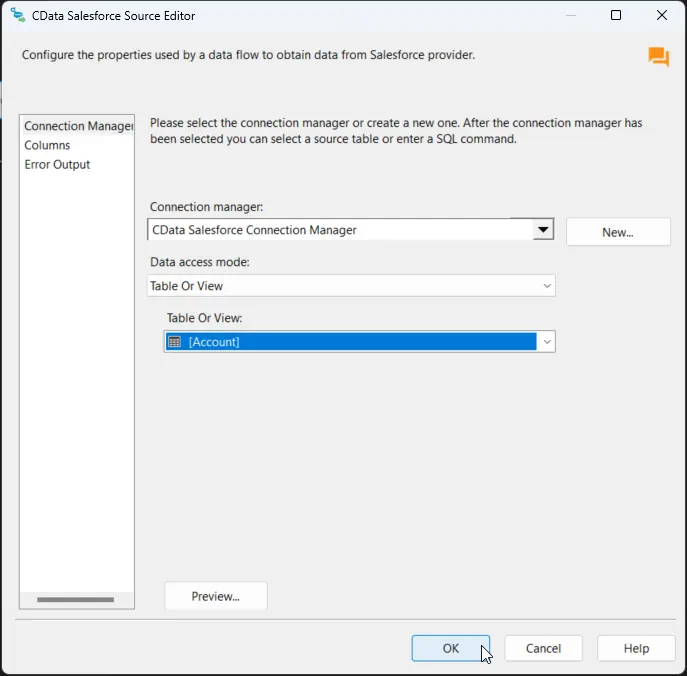
After saving the connection, select "Table or view" and select the table or view to export into Snowflake, then close the CData SAP Ariba Procurement Source Editor.
Configure the Snowflake destination
With the SAP Ariba Procurement Source configured, we can configure the Snowflake connection and map the columns.
-
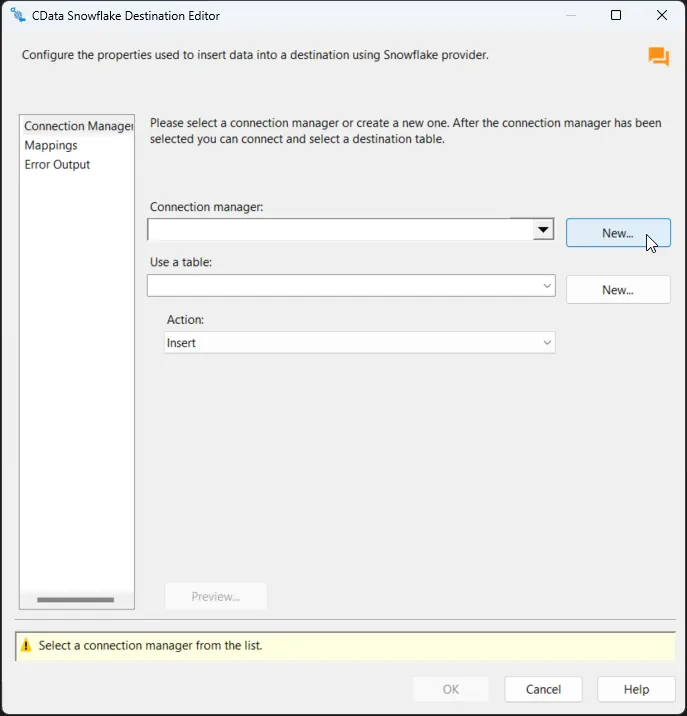
Double-click the CData Snowflake Destination to open the destination component editor and add a new connection.
-
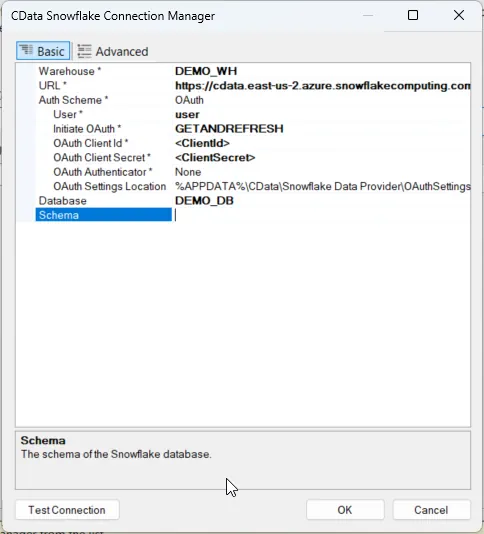
In the CData Snowflake Connection Manager, configure the connection properties, then test and save the connection.
- The component supports Snowflake user authentication, federated authentication, and SSL client authentication. To authenticate, set User and Password, and select the authentication method in the AuthScheme property. Starting with accounts created using Snowflake’s bundle 2024_08 (October 2024), password-based authentication is no longer supported due to security concerns. Instead, use alternative authentication methods such as OAuth or Private Key authentication.
Other helpful connection properties
- QueryPassthrough: When this is set to True, queries are passed through directly to Snowflake.
- ConvertDateTimetoGMT: When this is set to True, the components will convert date-time values to GMT, instead of the local time of the machine.
- IgnoreCase: A session parameter that specifies whether Snowflake will treat identifiers as case sensitive. Default: false(case is sensitive).
- BindingType: There are two kinds of binding types: DEFAULT and TEXT. DEFAULT uses the binding type DATE for the Date type, TIME for the Time type, and TIMESTAMP_* for the Timestamp_* type. TEST uses the binding type TEXT for Date, Time, and Timestamp_* types.
-
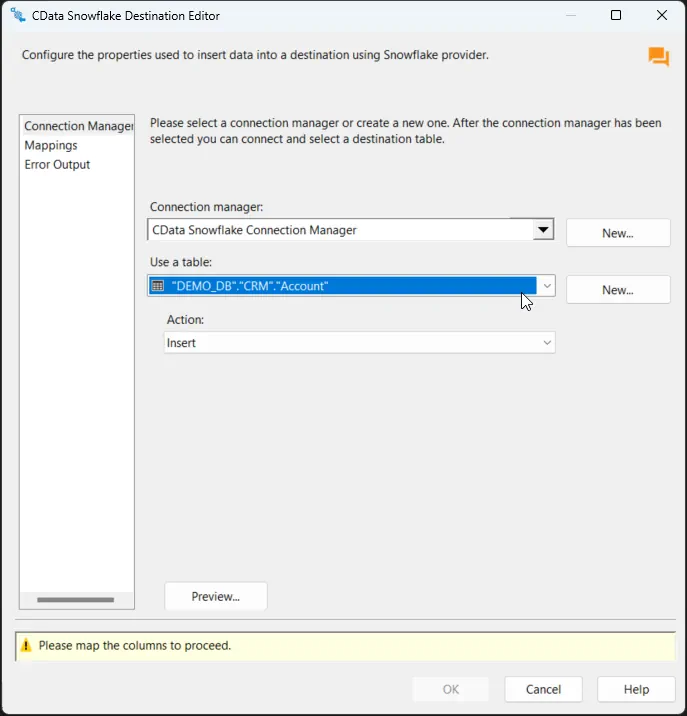
After saving the connection, select a table in the Use a Table menu and in the Action menu, select Insert.
-
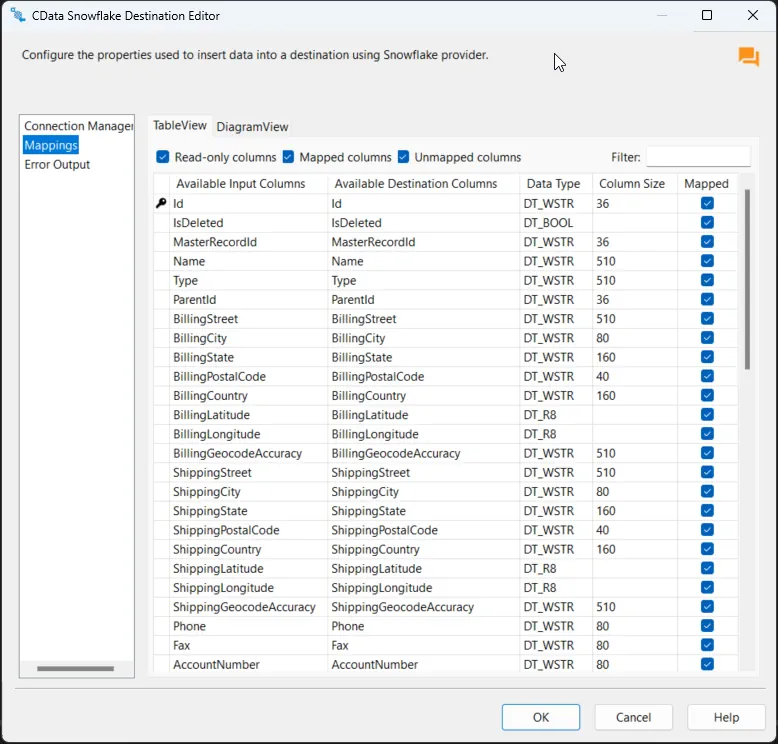
On the Column Mappings tab, configure the mappings from the input columns to the destination columns.
Run the project
You can now run the project. After the SSIS Task has finished executing, data from your SQL table will be exported to the chosen table.
Ready to get started?
Download a free trial of the SAP Ariba Procurement SSIS Component to get started:
Download NowLearn more:
 SAP Ariba Procurement SSIS Components
Powerful SSIS Source & Destination Components that allows you to easily connect SQL Server with SAP Ariba Procurement through SSIS Workflows.
Use the SAP Ariba Procurement Data Flow Components to synchronize with SAP Ariba Procurement 0, and more. Perfect for data synchronization, local back-ups, workflow automation, and more!
